
说明
本文是个人学习用的非官方中英对照译文,原文:https://diveintosystems.org/book/C7-x86_64/functions.html。
原书采用 CC BY-NC-ND 4.0 许可(禁止演绎),请勿公开传播本译文。
标为「译注」「现代更新」的内容是译者补充,不代表原书作者观点;代码与原文逐字一致,未作改动。
7.5. Functions in Assembly
在上一节中,我们跟踪了汇编中的一些简单函数。本节在一个较大程序的背景下,讨论汇编中多个函数之间的交互。我们还会介绍一些与函数管理有关的新指令。
In the previous section, we traced through simple functions in assembly. In this section, we discuss the interaction between multiple functions in assembly in the context of a larger program. We also introduce some new instructions involved with function management.
我们先复习一下调用栈是如何管理的。回想一下,%rsp 是栈指针,总是指向栈顶。寄存器 %rbp 表示基址指针(也称帧指针),指向当前栈帧的底部。栈帧(stack frame,也称活动帧或活动记录)指的是栈中分配给单次函数调用的那一部分。当前正在执行的函数总是位于栈顶,它的栈帧称为活动帧(active frame)。活动帧的边界由栈指针(在栈顶)和帧指针(在帧底)界定。活动记录中通常存放着函数的局部变量。
Let’s begin with a refresher on how the call stack is managed. Recall that
%rspis the stack pointer and always points to the top of the stack. The register%rbprepresents the base pointer (also known as the frame pointer) and points to the base of the current stack frame. The stack frame (also known as the activation frame or the activation record) refers to the portion of the stack allocated to a single function call. The currently executing function is always at the top of the stack, and its stack frame is referred to as the active frame. The active frame is bounded by the stack pointer (at the top of stack) and the frame pointer (at the bottom of the frame). The activation record typically holds local variables for a function.
图 1 展示了 main 及其调用的一个名为 fname 的函数的栈帧。我们把 main 函数称为调用者(caller)函数,把 fname 称为被调用者(callee)函数。
Figure 1 shows the stack frames for
mainand a function it calls namedfname. We will refer to themainfunction as the caller function andfnameas the callee function.
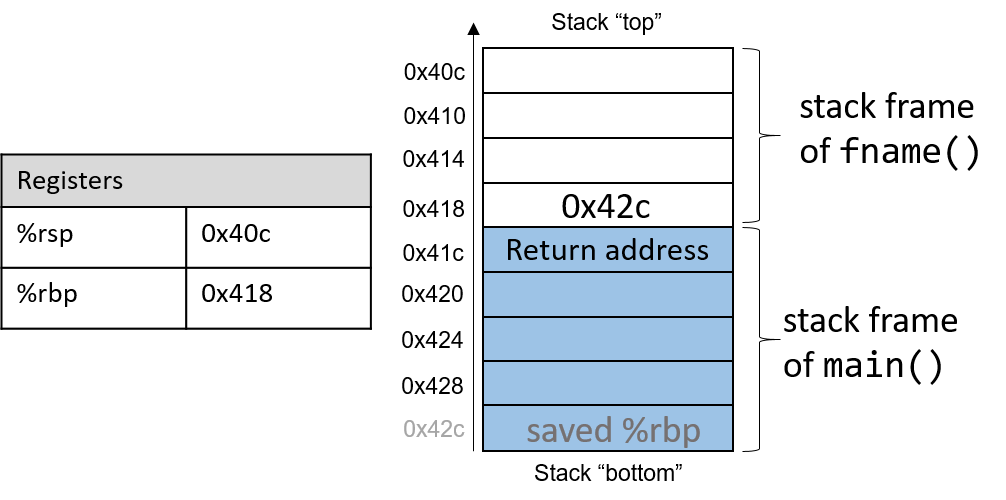
图 1. 栈帧的管理
Figure 1. Stack frame management
在图 1 中,当前的活动帧属于被调用者函数(fname)。栈指针和帧指针之间的内存用于存放局部变量。随着局部值被压入和弹出栈,栈指针会移动。与之不同,帧指针相对保持不变,指向当前栈帧的开头(底部)。因此,像 GCC 这样的编译器通常相对于帧指针来引用栈上的值。在图 1 中,活动帧的下边界是 fname 的基址指针,即栈地址 0x418。存放在地址 0x418 处的值是「保存的」%rbp 值(0x42c),它本身是一个地址,表示 main 函数活动帧的底部。main 活动帧的顶部以返回地址(return address)为界,返回地址表示被调用函数 fname 执行完毕后,程序在 main 函数中从哪里继续执行。
In Figure 1, the current active frame belongs to the callee function (
fname). The memory between the stack pointer and the frame pointer is used for local variables. The stack pointer moves as local values are pushed and popped from the stack. In contrast, the frame pointer remains relatively constant, pointing to the beginning (the bottom) of the current stack frame. As a result, compilers like GCC commonly reference values on the stack relative to the frame pointer. In Figure 1, the active frame is bounded below by the base pointer offname, which is stack address 0x418. The value stored at address 0x418 is the “saved”%rbpvalue (0x42c), which itself is an address that indicates the bottom of the activation frame for themainfunction. The top of the activation frame ofmainis bounded by the return address, which indicates where in themainfunction program execution resumes once the callee functionfnamefinishes executing.
原书警示 · 返回地址指向代码段内存,而不是栈内存(The return address points to code segment memory, not stack memory)
回想一下,程序的调用栈区域(栈内存)与其代码区域(代码段内存)是不同的。%rbp 和 %rsp 指向栈内存中的地址,而 %rip 指向代码段内存中的地址。换句话说,返回地址是代码段内存中的一个地址,而不是栈内存中的地址:
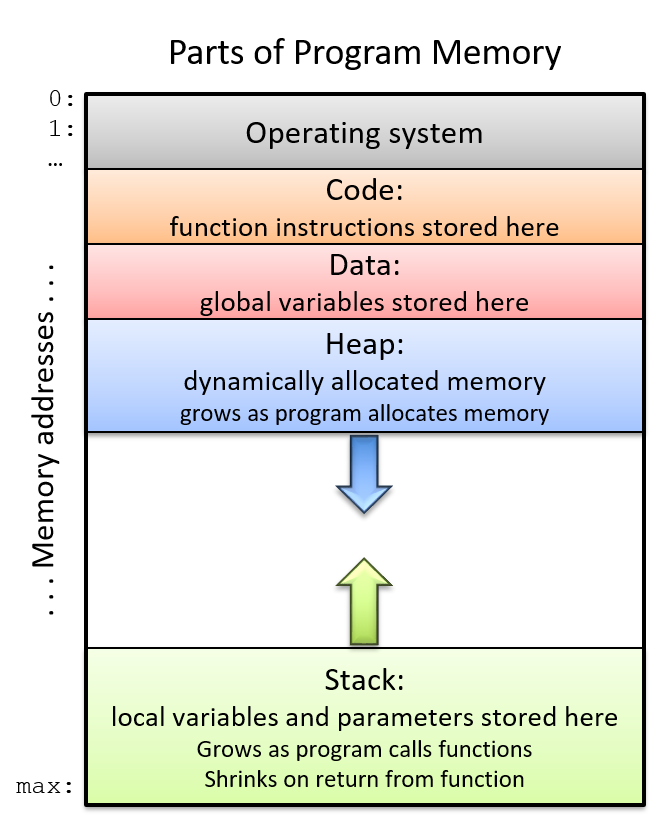
图示:程序地址空间的组成部分
Recall that the call stack region (stack memory) of a program is different from its code region (code segment memory). While
%rbpand%rsppoint to addresses in the stack memory,%rippoints to an address in code segment memory. In other words, the return address is an address in code segment memory, not stack memory:Figure 2. The parts of a program’s address space
表 1 列出了编译器用于基本函数管理的另外几条指令。
Table 1 contains several additional instructions that the compiler uses for basic function management.
表 1. 常用的函数管理指令
Table 1. Common Function Management Instructions
指令
Instruction
leaveq
leaveq
含义
Translation
为离开函数准备好栈。等价于:
Prepares the stack for leaving a function. Equivalent to:
1 | mov %rbp, %rsp |
指令
Instruction
callq addr <fname>
callq addr <fname>
含义
Translation
把活动帧切换到被调用者函数。等价于:
Switches active frame to callee function. Equivalent to:
1 | push %rip |
指令
Instruction
retq
retq
含义
Translation
把活动帧恢复为调用者函数。等价于:
Restores active frame to caller function. Equivalent to:
1 | pop %rip |
例如,leaveq 指令是编译器在准备离开函数时,用来恢复栈指针和帧指针的简写形式。当被调用函数执行完毕时,leaveq 确保帧指针被恢复为之前的值。
For example, the
leaveqinstruction is a shorthand that the compiler uses to restore the stack and frame pointers as it prepares to leave a function. When the callee function finishes execution,leaveqensures that the frame pointer is restored to its previous value.
callq 和 retq 指令在一个函数调用另一个函数的过程中起着重要作用。两条指令都会修改指令指针(寄存器 %rip)。当调用者函数执行 callq 指令时,%rip 的当前值被保存到栈上,作为返回地址,即被调用函数执行完毕后调用者继续执行的程序地址。callq 指令还会用被调用函数的地址替换 %rip 的值。
The
callqandretqinstructions play a prominent role in the process where one function calls another. Both instructions modify the instruction pointer (register%rip). When the caller function executes thecallqinstruction, the current value of%ripis saved on the stack to represent the return address, or the program address at which the caller resumes executing once the callee function finishes. Thecallqinstruction also replaces the value of%ripwith the address of the callee function.
retq 指令把 %rip 的值恢复为保存在栈上的值,确保程序在调用者函数中指定的程序地址处继续执行。被调用者返回的任何值都存放在 %rax 或它的某个组成部分寄存器(例如 %eax)中。retq 指令通常是任何函数中执行的最后一条指令。
The
retqinstruction restores the value of%ripto the value saved on the stack, ensuring that the program resumes execution at the program address specified in the caller function. Any value returned by the callee is stored in%raxor one of its component registers (e.g.,%eax). Theretqinstruction is usually the last instruction that executes in any function.
7.5.1. 函数参数
7.5.1. Function Parameters
与 IA32 不同,函数参数通常在函数调用之前就被预先加载到寄存器中。表 2 列出了函数的各个参数,以及在函数调用之前它们被加载到的寄存器(如果有的话)。
Unlike IA32, function parameters are typically preloaded into registers prior to a function call. Table 2 lists the parameters to a function and the register (if any) that they are loaded into prior to a function call.
表 2. 函数参数的位置
Table 2. Locations of Function Parameters.
| 参数 | 位置 |
|---|---|
| 参数 1 | %rdi |
| 参数 2 | %rsi |
| 参数 3 | %rdx |
| 参数 4 | %rcx |
| 参数 5 | %r8 |
| 参数 6 | %r9 |
| 参数 7 及以后 | 调用栈上 |
Parameter Location Parameter 1 %rdi Parameter 2 %rsi Parameter 3 %rdx Parameter 4 %rcx Parameter 5 %r8 Parameter 6 %r9 Parameter 7+ on call stack
函数的前六个参数依次被加载到寄存器 %rdi、%rsi、%rdx、%rcx、%r8 和 %r9 中。其余的参数按照各自的大小依次被加载到调用栈上(32 位数据以 4 字节为偏移,64 位数据以 8 字节为偏移)。
The first six parameters to a function are loaded into registers
%rdi,%rsi,%rdx,%rcx,%r8, and%r9, respectively. Any additional parameters are successively loaded into the call stack based on their size (4 byte offsets for 32-bit data, 8 byte offsets for 64-bit data).
译注
这是 Linux、macOS 等系统在 x86-64 上遵循的 System V AMD64 调用约定,栈上传递的参数实际上每个都占 8 字节的槽位。Windows x64 用的是另一套约定:只有前四个整数参数用寄存器传递(rcx、rdx、r8、r9)。
7.5.2. 跟踪一个例子
7.5.2. Tracing Through an Example
运用关于函数管理的知识,我们来跟踪本章开头首次介绍的那个代码示例。注意,我们在每个函数定义的参数列表中加上了 void 关键字,指明这些函数不接收参数。这一改动不会改变程序的输出,但确实会简化对应的汇编。
Using our knowledge of function management, let’s trace through the code example first introduced at the beginning of this chapter. Note that the
voidkeyword is added to the parameter list of each function definition to specify that the functions take no arguments. This change does not modify the output of the program; however, it does simplify the corresponding assembly.
1 | #include <stdio.h> |
我们用命令 gcc -o prog prog.c 编译这段代码,并用 objdump -d 查看底层的汇编。后一条命令会输出一个相当大的文件,里面有很多我们不需要的信息。用 less 及其搜索功能提取出 adder、assign 和 main 函数:
We compile this code with the command
gcc -o prog prog.cand useobjdump -dto view the underlying assembly. The latter command outputs a pretty big file that contains a lot of information that we don’t need. Uselessand the search functionality to extract theadder,assign, andmainfunctions:
1 | 0000000000400526 <assign>: |
每个函数都以一个符号标签开头,它对应于该函数在程序中声明的名字。例如,<main>: 是 main 函数的符号标签。函数标签的地址也就是该函数第一条指令的地址。为了在下面的图中节省空间,我们把地址截断为低 12 位。所以,程序地址 0x400542 显示为 0x542。
Each function begins with a symbolic label that corresponds to its declared name in the program. For example,
<main>:is the symbolic label for themainfunction. The address of a function label is also the address of the first instruction in that function. To save space in the figures below, we truncate addresses to the lower 12 bits. So, program address 0x400542 is shown as 0x542.
7.5.3. 跟踪 main
7.5.3. Tracing Through main
图 3 展示了紧接在 main 执行之前的执行栈。
Figure 3 shows the execution stack immediately prior to the execution of
main.
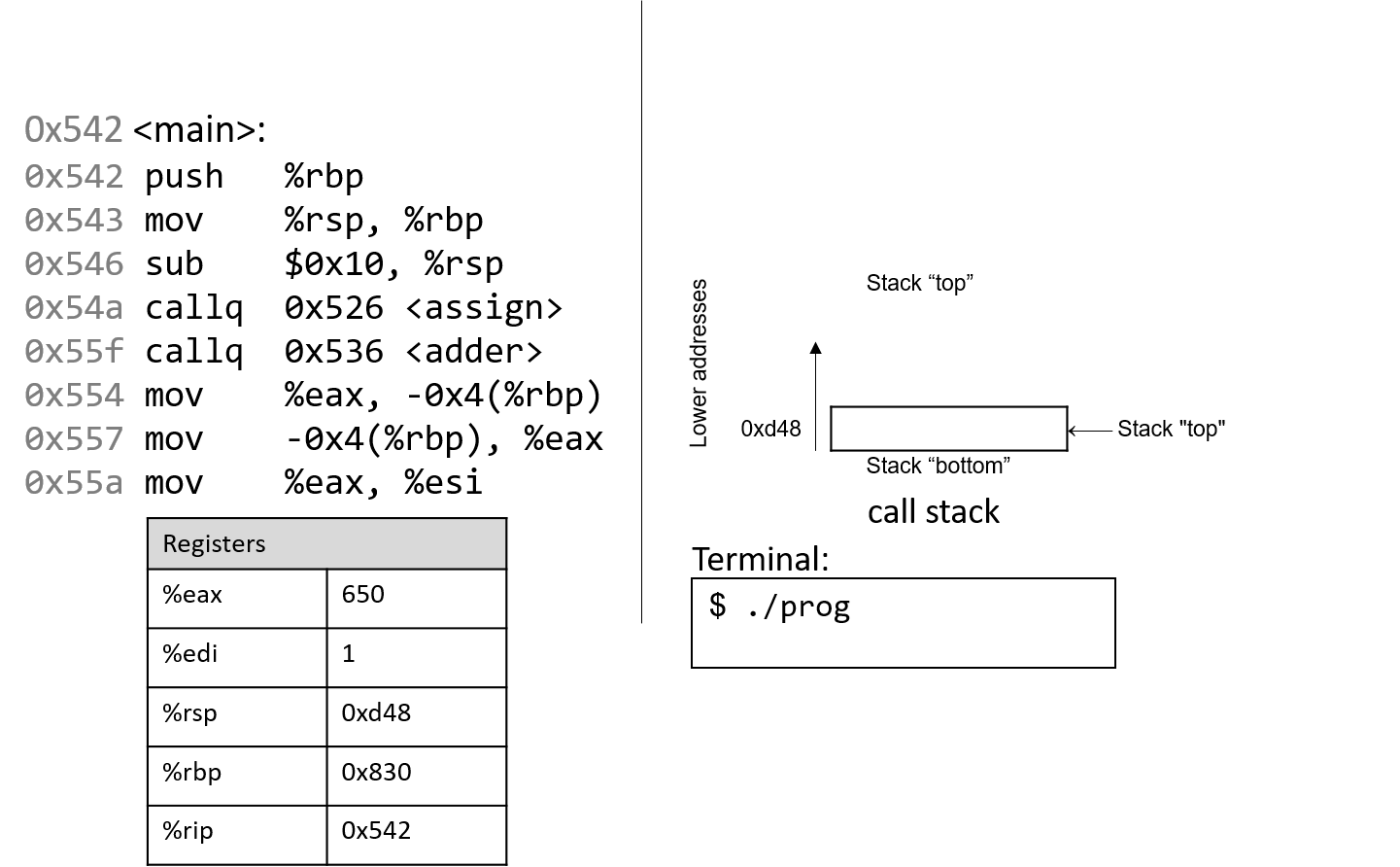
图 3. 执行 main 函数之前 CPU 寄存器和调用栈的初始状态
Figure 3. The initial state of the CPU registers and call stack prior to executing the main function
回想一下,栈向较低的地址增长。在这个例子中,%rbp 最初是栈地址 0x830,%rsp 最初是栈地址 0xd48。这两个值都是为这个例子编造的。
Recall that the stack grows toward lower addresses. In this example,
%rbpinitially is stack address 0x830, and%rspinitially is stack address 0xd48. Both of these values are made up for this example.
由于前面示例中的函数使用的是整数数据,我们突出显示组成部分寄存器 %eax 和 %edi,它们最初存放的是垃圾值。红色(左上角)箭头指示当前正在执行的指令。最初,%rip 中存放的是地址 0x542,即 main 函数第一行的程序内存地址。
Since the functions shown in the previous example utilize integer data, we highlight component registers
%eaxand%edi, which initially contain junk values. The red (upper-left) arrow indicates the currently executing instruction. Initially,%ripcontains address 0x542, which is the program memory address of the first line in themainfunction.
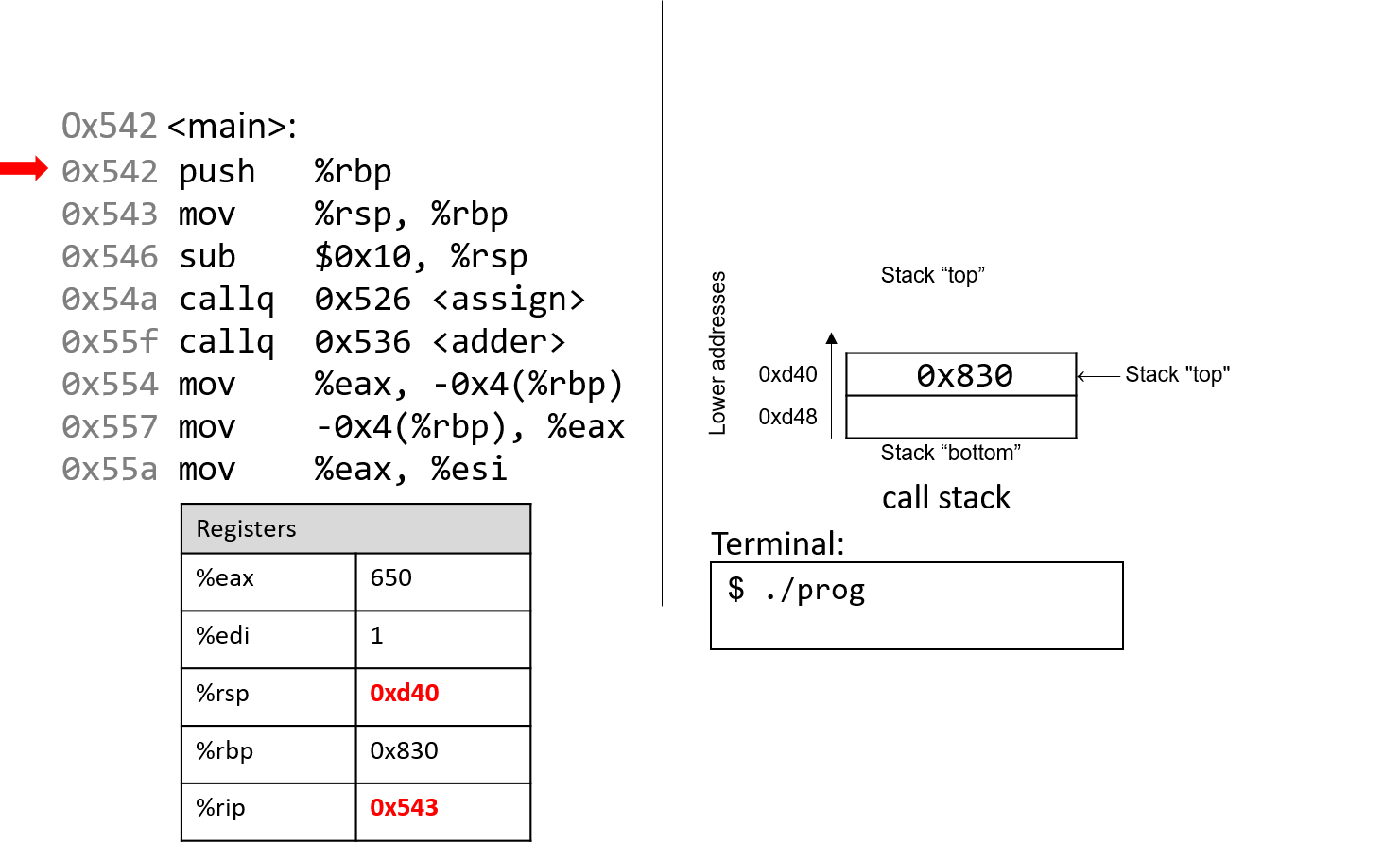
第一条指令通过把 0x830 压入栈来保存 %rbp 的当前值。由于栈向较低的地址增长,栈指针 %rsp 被更新为 0xd40,比 0xd48 小 8 个字节。%rip 前进到顺序中的下一条指令。
The first instruction saves the current value of
%rbpby pushing 0x830 onto the stack. Since the stack grows toward lower addresses, the stack pointer%rspis updated to 0xd40, which is 8 bytes less than 0xd48.%ripadvances to the next instruction in sequence.
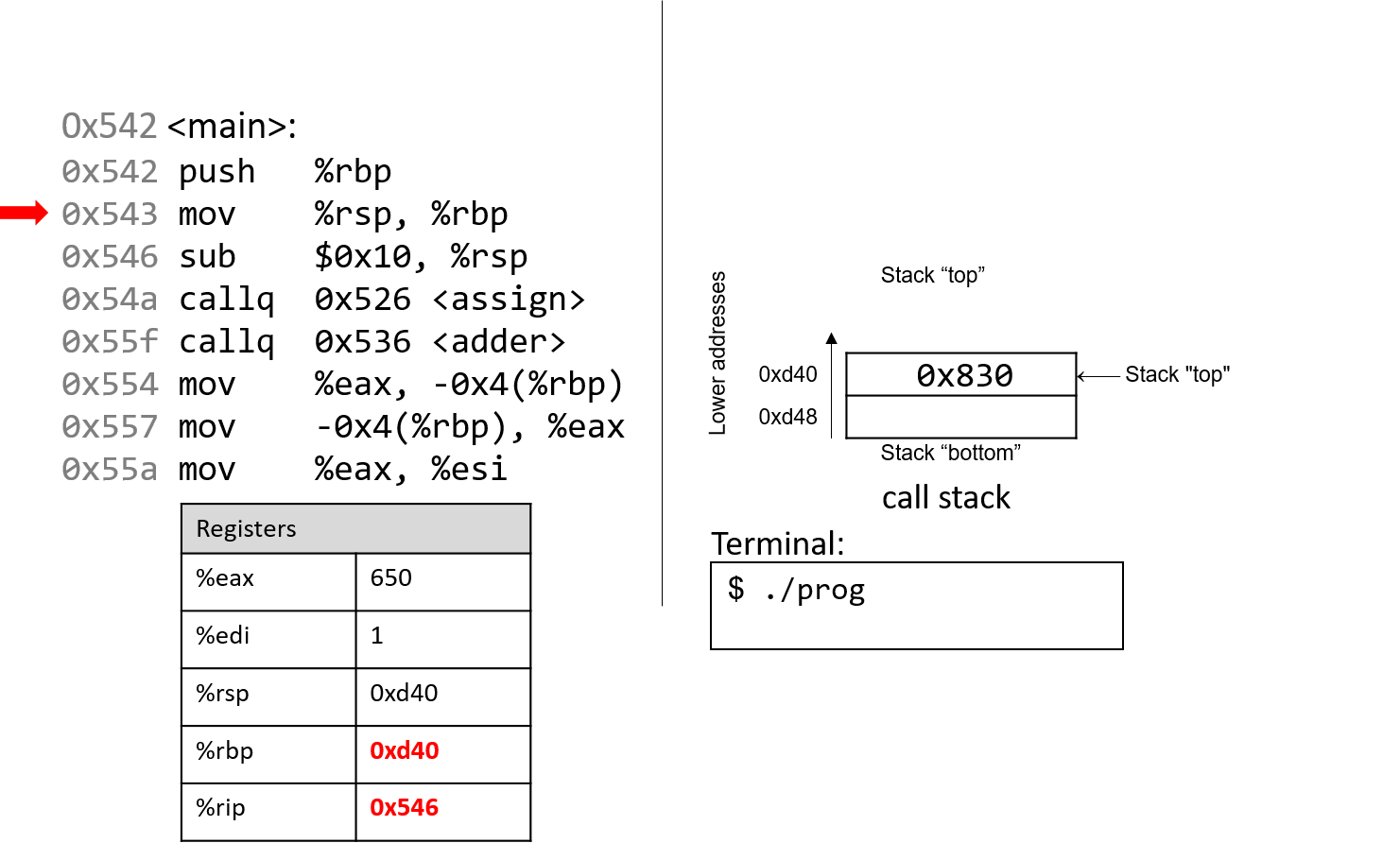
下一条指令(mov %rsp, %rbp)把 %rbp 的值更新为与 %rsp 相同。帧指针(%rbp)现在指向 main 函数栈帧的开头。%rip 前进到顺序中的下一条指令。
The next instruction (
mov %rsp, %rbp) updates the value of%rbpto be the same as%rsp. The frame pointer (%rbp) now points to the start of the stack frame for themainfunction.%ripadvances to the next instruction in sequence.
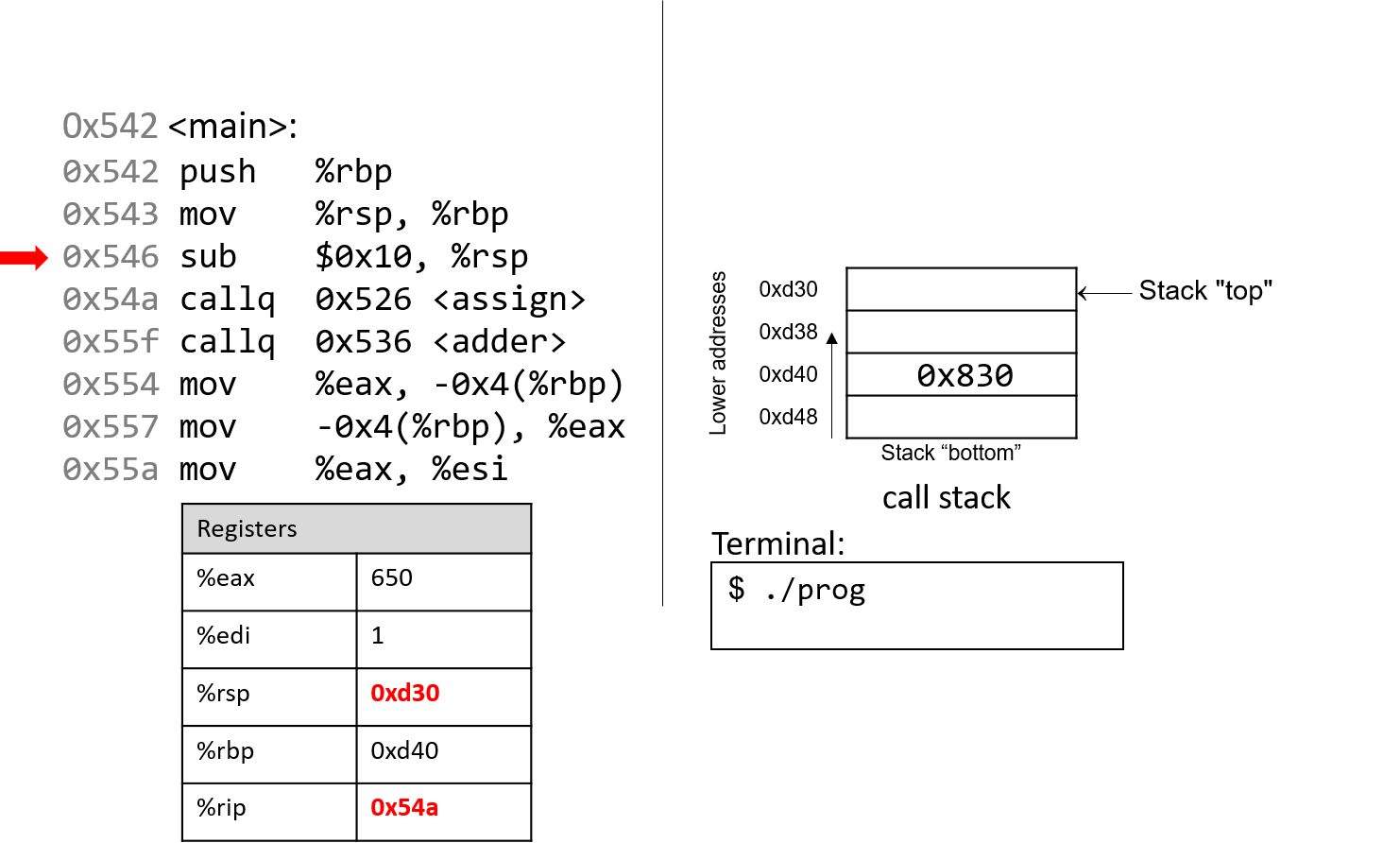
sub 指令从栈指针的地址中减去 0x10,这实际上使栈「增长」了 16 个字节,我们在图中用栈上的两个 8 字节位置来表示。因此寄存器 %rsp 的新值是 0xd30。%rip 前进到顺序中的下一条指令。
The
subinstruction subtracts 0x10 from the address of our stack pointer, which essentially causes the stack to “grow” by 16 bytes, which we represent by showing two 8-byte locations on the stack. Register%rsptherefore has the new value of 0xd30.%ripadvances to the next instruction in sequence.
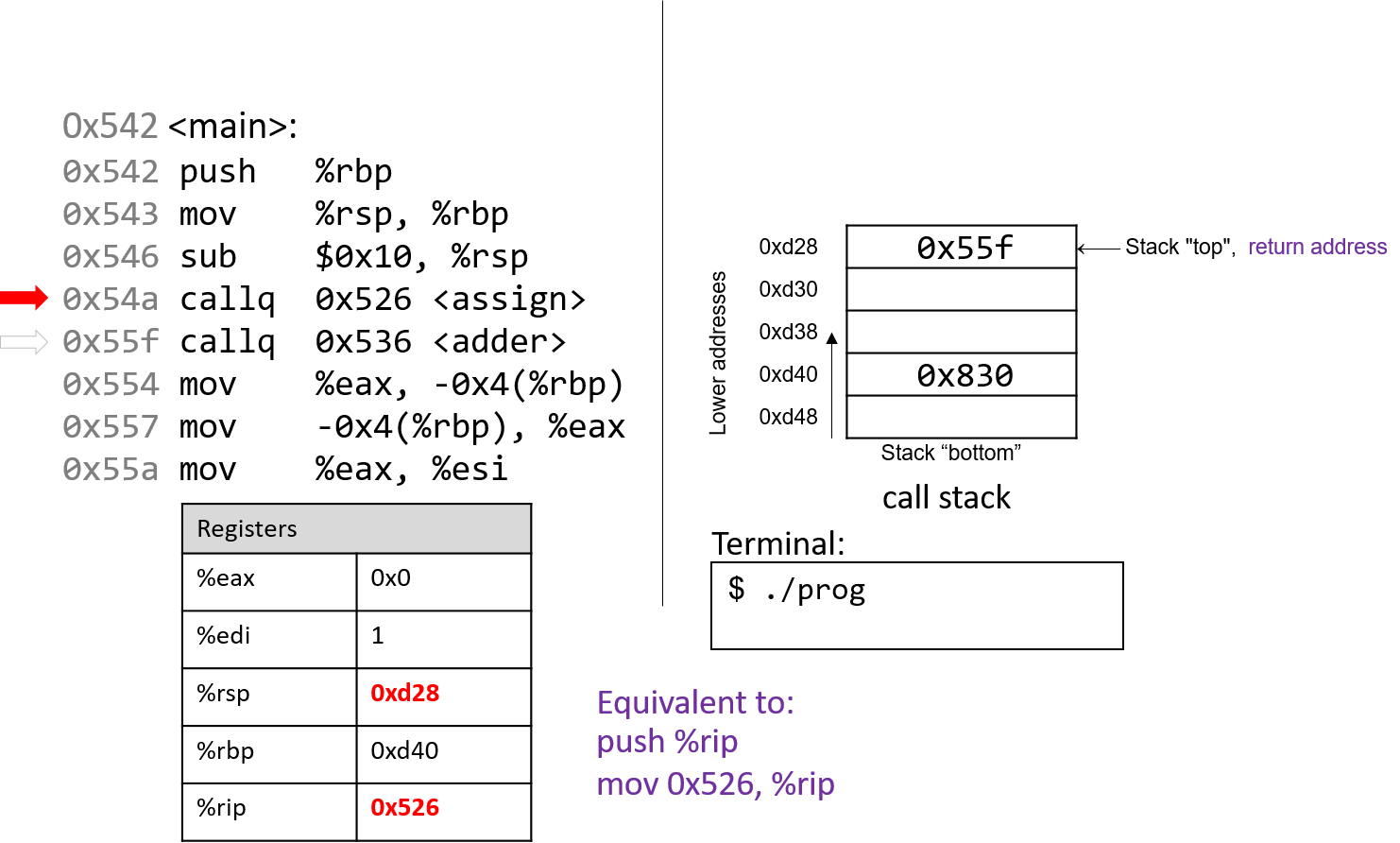
callq <assign> 指令把寄存器 %rip 中的值(它表示下一条要执行的指令的地址)压入栈。由于 callq <assign> 之后的下一条指令的地址是 0x55f,这个值作为返回地址被压入栈。回想一下,返回地址表示程序执行返回到 main 时应当从哪个程序地址继续执行。
The
callq <assign>instruction pushes the value inside register%rip(which denotes the address of the next instruction to execute) onto the stack. Since the next instruction aftercallq <assign>has an address of 0x55f, that value is pushed onto the stack as the return address. Recall that the return address indicates the program address where execution should resume when program execution returns tomain.
译注
对照上面的 objdump 输出,callq <assign> 位于 0x40054a,它的下一条指令(callq <adder>)位于 0x40054f,所以截断后的返回地址应为 0x54f 而不是 0x55f。下文「%rip 前进到地址 0x55f 处的 callq 指令」中的 0x55f 同样应为 0x54f。
接着,callq 指令把 assign 函数的地址(0x526)移入寄存器 %rip,表示程序的执行应当继续进入被调用函数 assign,而不是 main 中的下一条指令。
Next, the
callqinstruction moves the address of theassignfunction (0x526) into register%rip, signifying that program execution should continue into the callee functionassignand not the next instruction inmain.
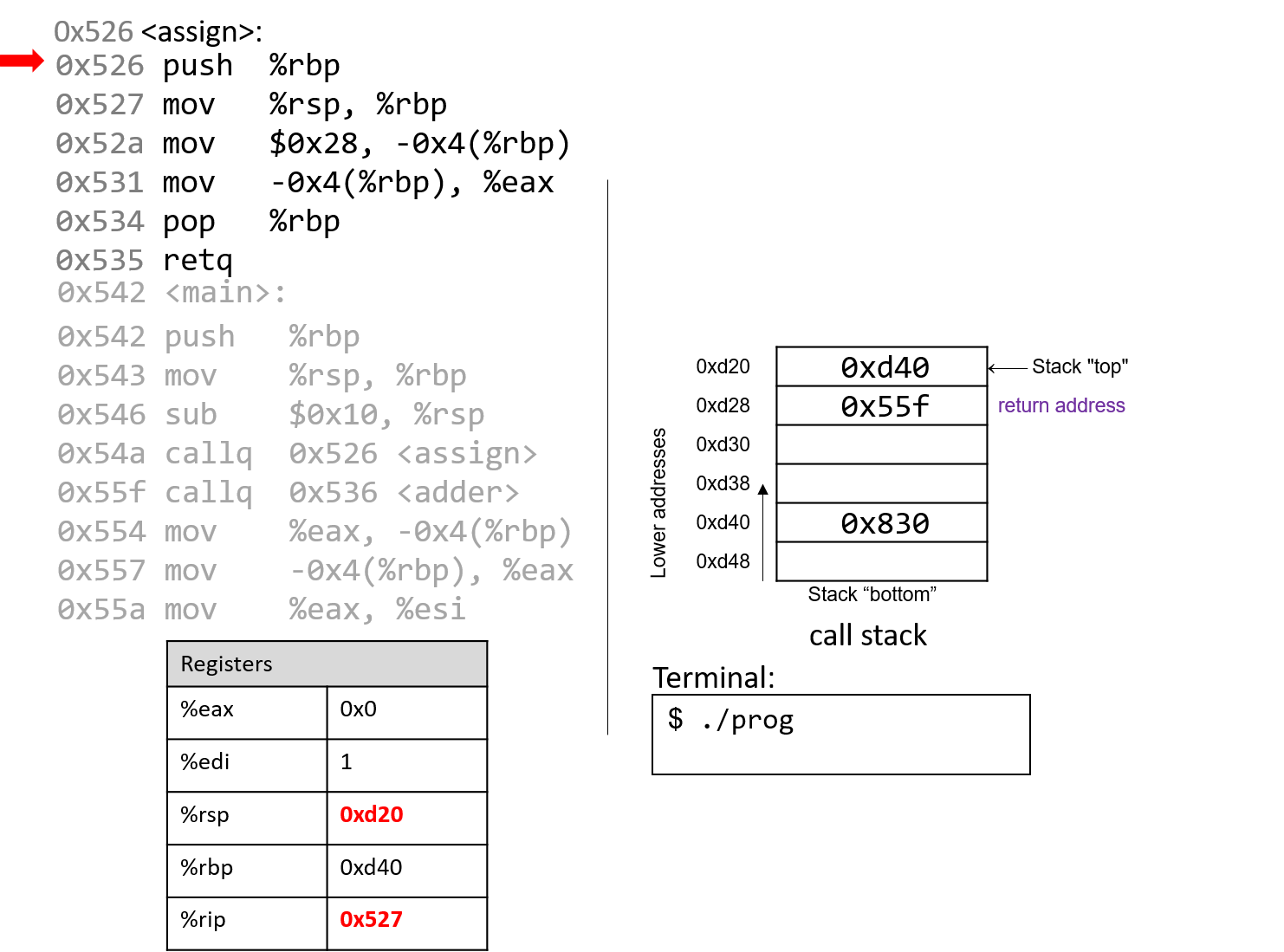
assign 函数中执行的前两条指令是每个函数都要做的例行簿记工作。第一条指令把 %rbp 中存放的值(内存地址 0xd40)压入栈。回想一下,这个地址指向 main 栈帧的开头。%rip 前进到 assign 中的第二条指令。
The first two instructions that execute in the
assignfunction are the usual book-keeping that every function performs. The first instruction pushes the value stored in%rbp(memory address 0xd40) onto the stack. Recall that this address points to the beginning of the stack frame formain.%ripadvances to the second instruction inassign.
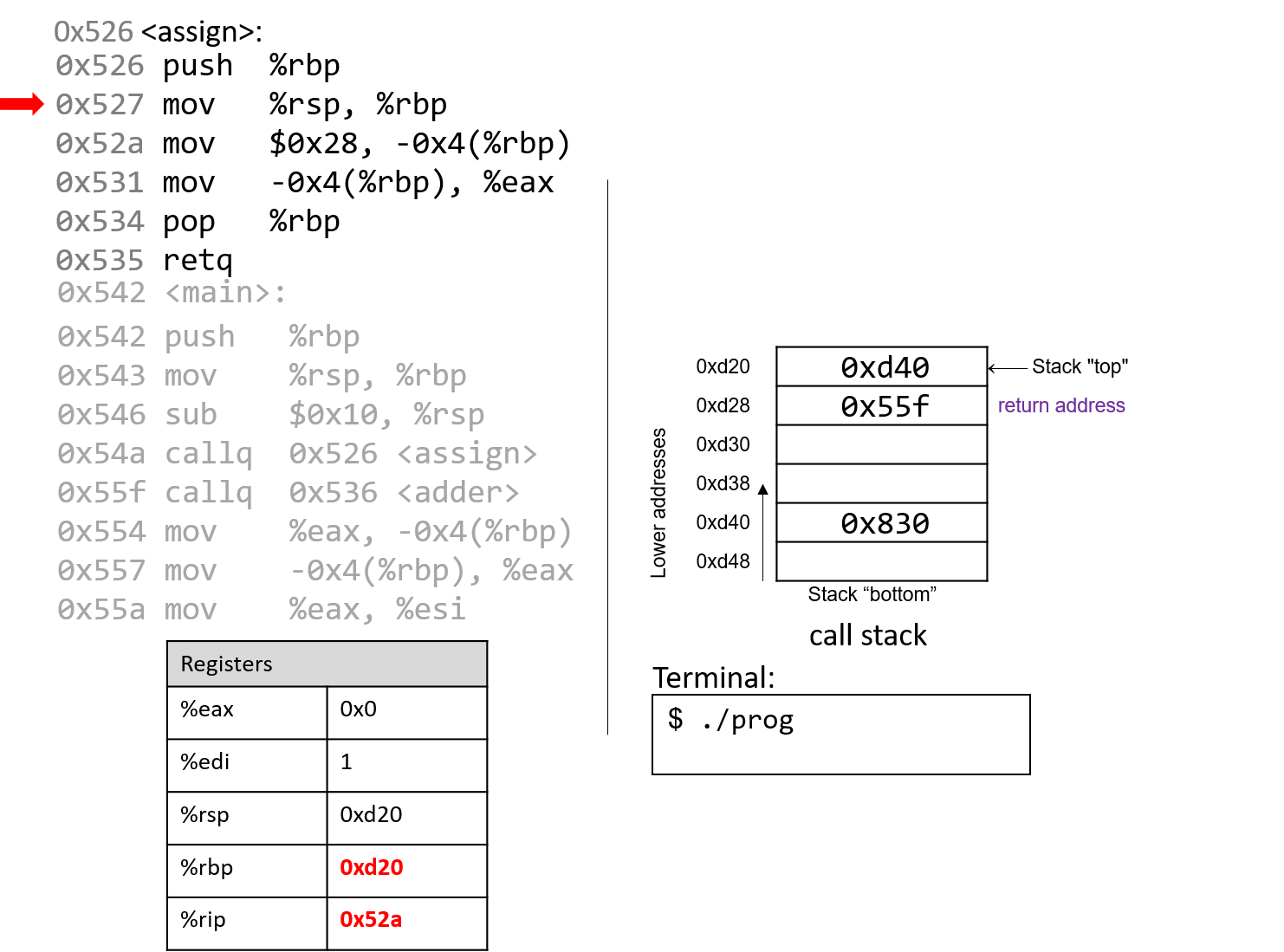
下一条指令(mov %rsp, %rbp)把 %rbp 更新为指向栈顶,标志着 assign 栈帧的开始。指令指针(%rip)前进到 assign 函数中的下一条指令。
The next instruction (
mov %rsp, %rbp) updates%rbpto point to the top of the stack, marking the beginning of the stack frame forassign. The instruction pointer (%rip) advances to the next instruction in theassignfunction.
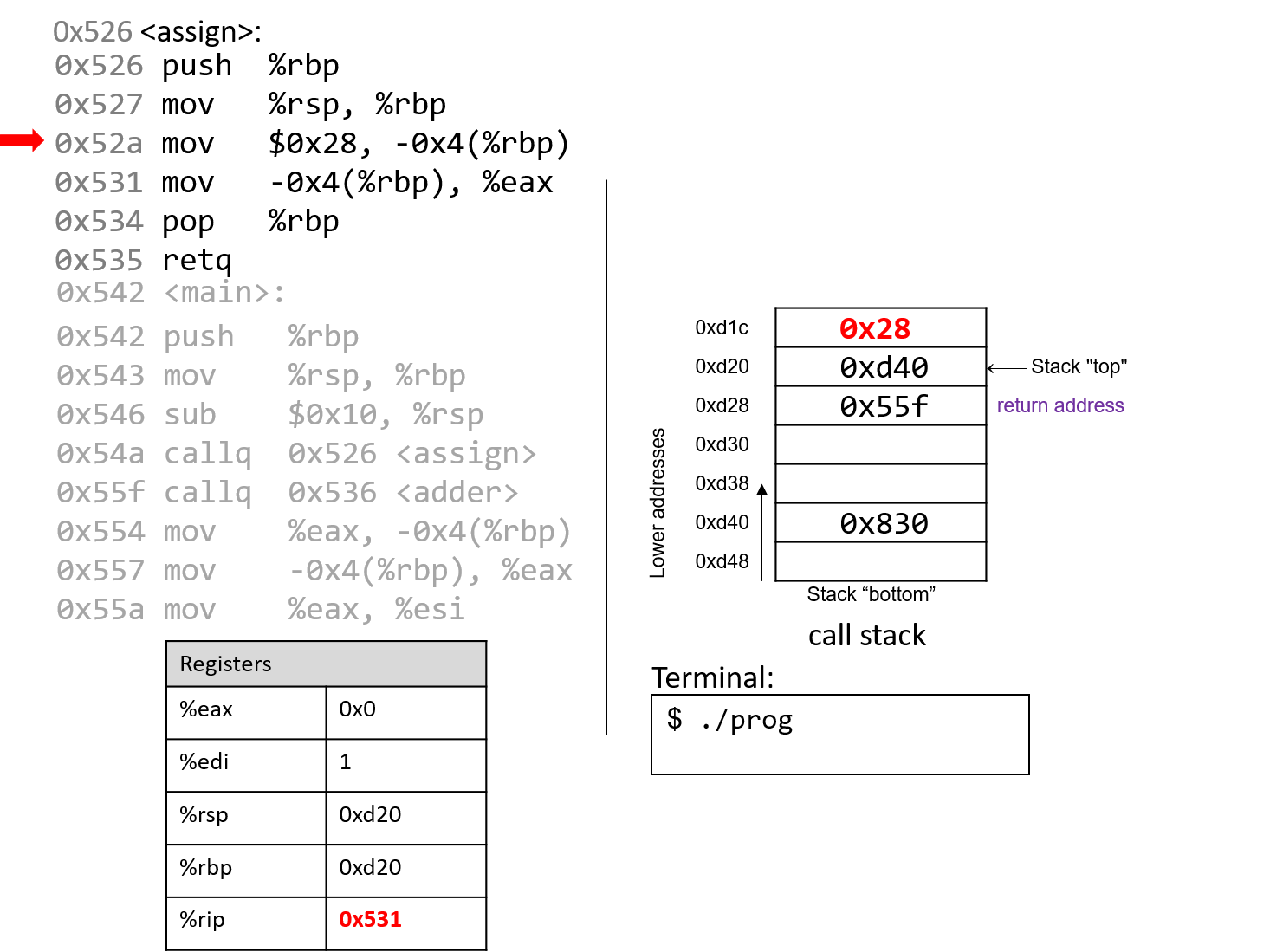
地址 0x52a 处的 mov 指令把值 $0x28(即 40)移到栈上的地址 -0x4(%rbp) 处,这个位置在帧指针上方四个字节。回想一下,帧指针通常用来引用栈上的位置。不过要记住,这个操作不会改变 %rsp 的值——栈指针仍然指向地址 0xd20。寄存器 %rip 前进到 assign 函数中的下一条指令。
The
movinstruction at address 0x52a moves the value$0x28(or 40) onto the stack at address-0x4(%rbp), which is four bytes above the frame pointer. Recall that the frame pointer is commonly used to reference locations on the stack. However, keep in mind that this operation does not change the value of%rsp— the stack pointer still points to address 0xd20. Register%ripadvances to the next instruction in theassignfunction.
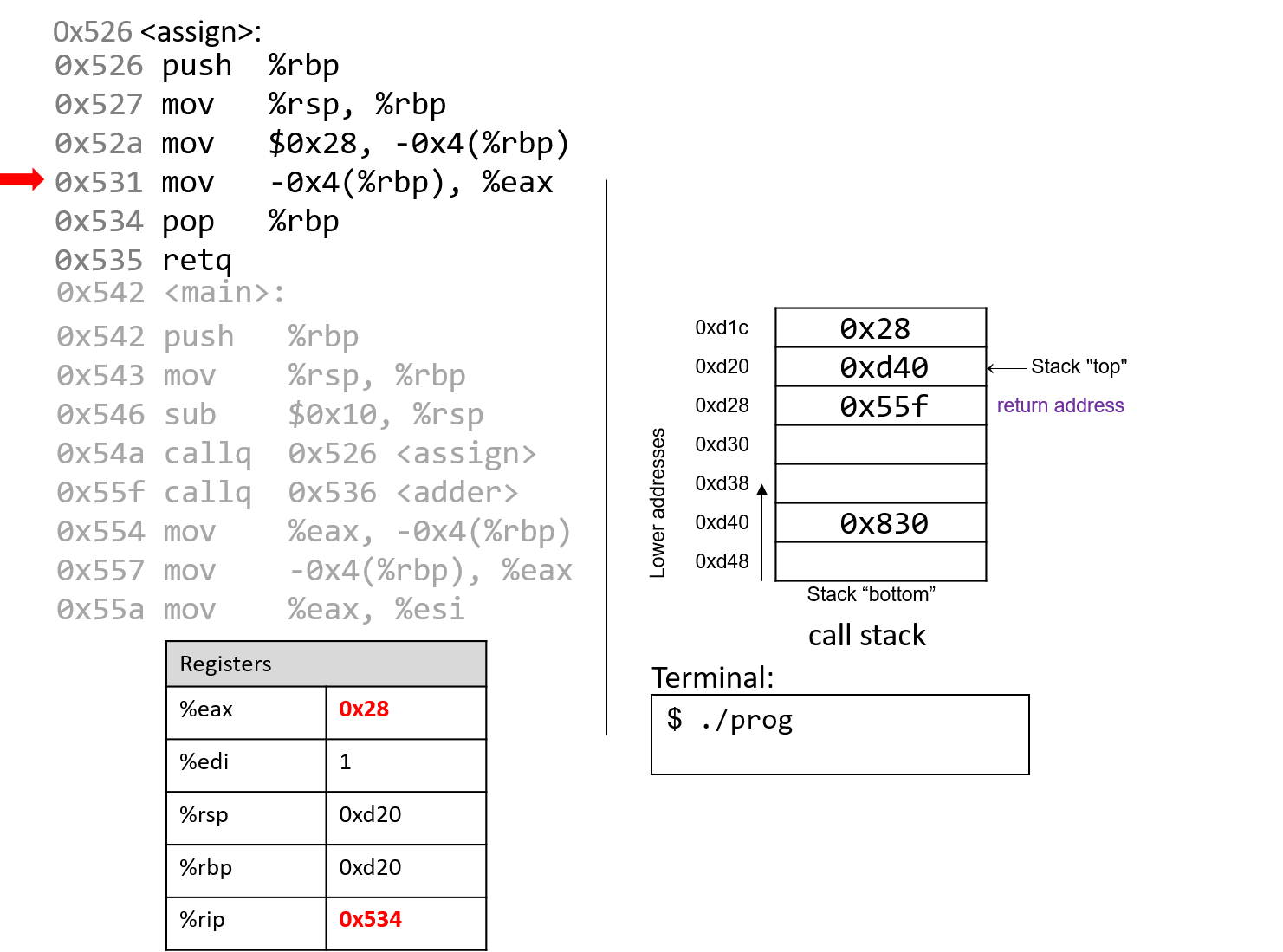
地址 0x531 处的 mov 指令把值 $0x28 放入寄存器 %eax,它存放函数的返回值。%rip 前进到 assign 函数中的 pop 指令。
The
movinstruction at address 0x531 places the value$0x28into register%eax, which holds the return value of the function.%ripadvances to thepopinstruction in theassignfunction.
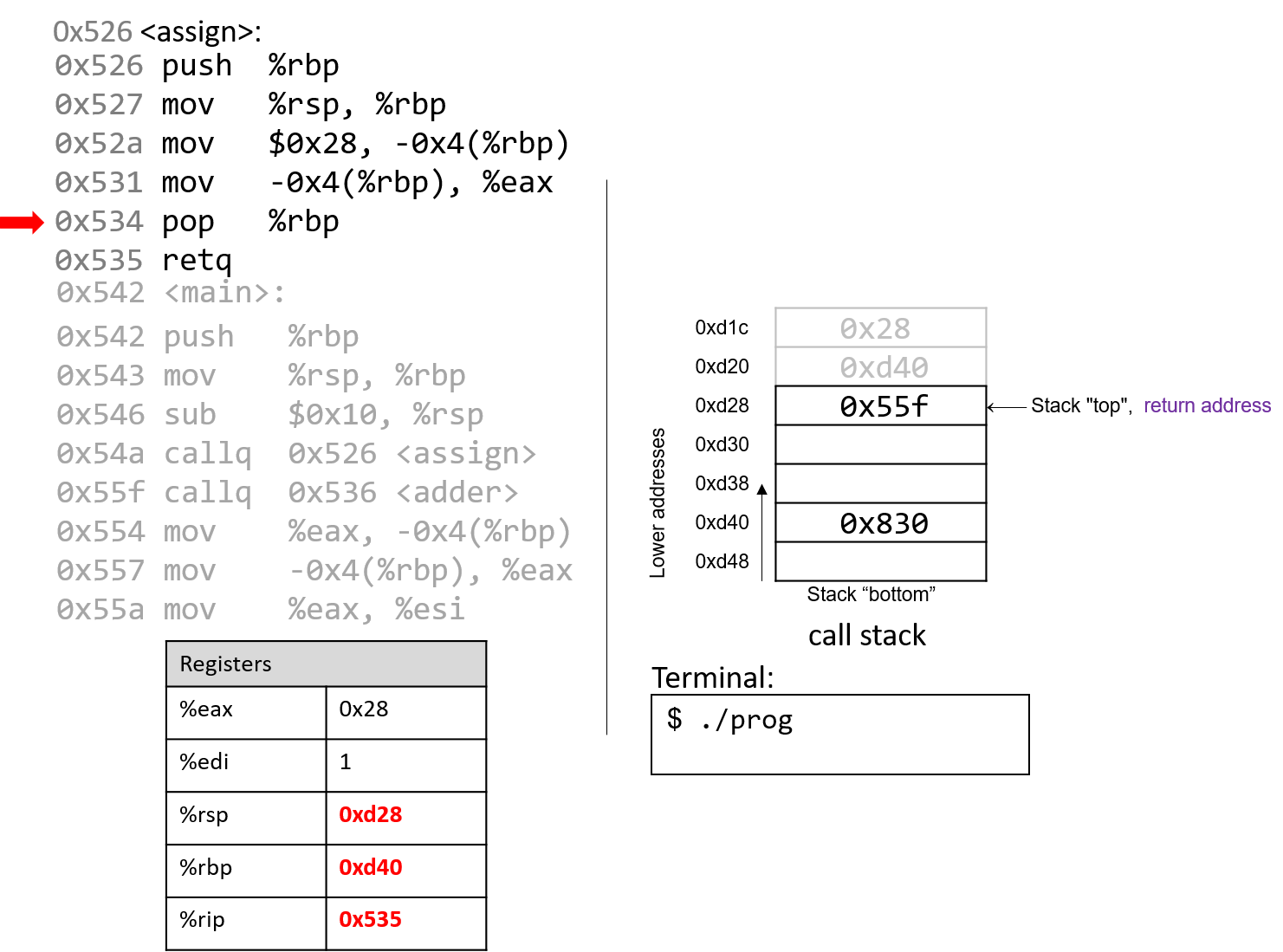
此时,assign 函数几乎已经执行完毕。接下来执行的指令是 pop %rbp,它把 %rbp 恢复为之前的值,即 0xd40。由于 pop 指令会修改栈指针,%rsp 被更新为 0xd28。
At this point, the
assignfunction has almost completed execution. The next instruction that executes ispop %rbp, which restores%rbpto its previous value, or 0xd40. Since thepopinstruction modifies the stack pointer,%rspupdates to 0xd28.
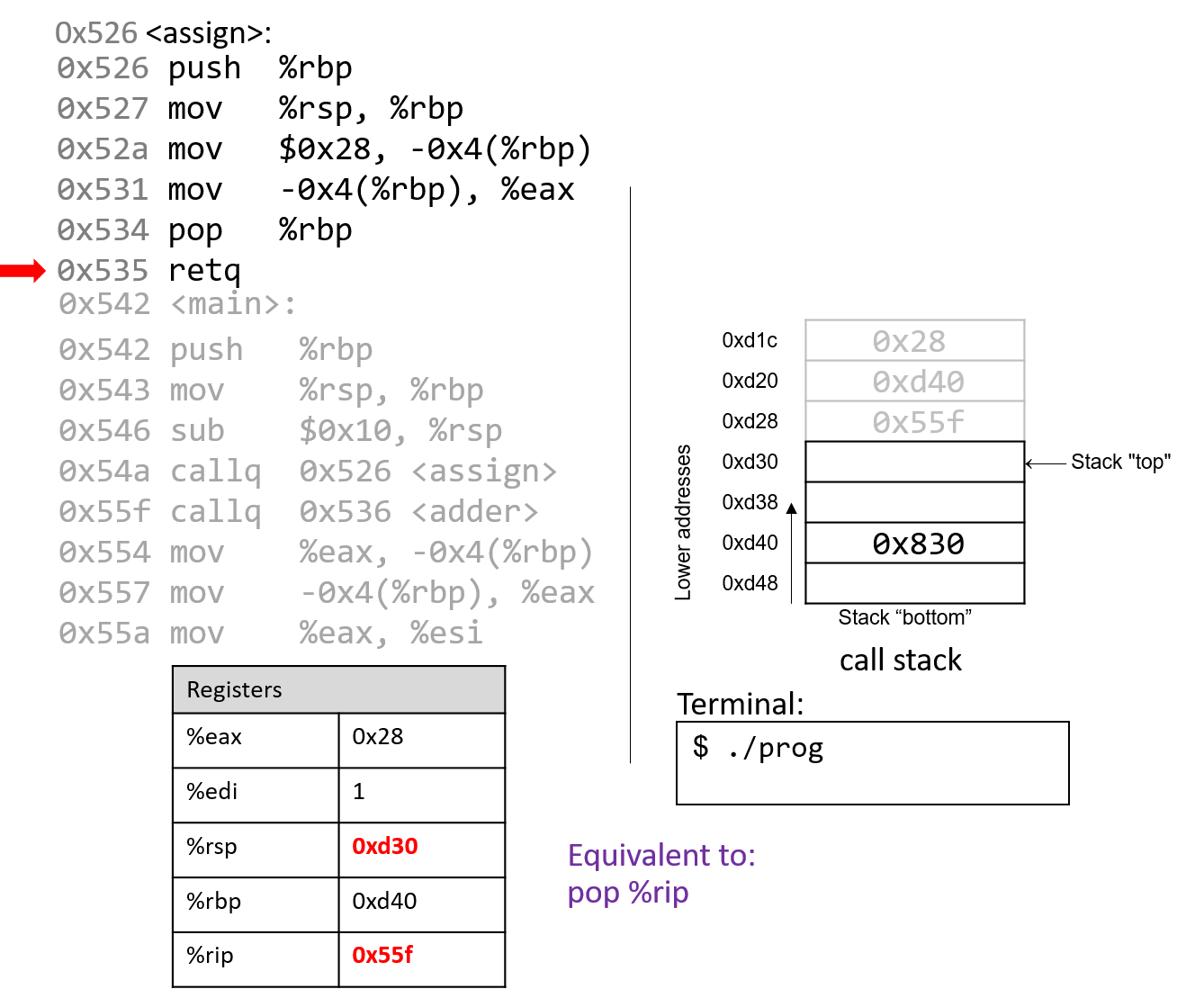
assign 中的最后一条指令是 retq。retq 执行时,返回地址被从栈中弹出到寄存器 %rip。在我们的例子中,%rip 现在前进到指向 main 中位于地址 0x55f 处的 callq 指令。
The last instruction in
assignis aretqinstruction. Whenretqexecutes, the return address is popped off the stack into register%rip. In our example,%ripnow advances to point to thecallqinstruction inmainat address 0x55f.
此时有几件重要的事值得注意:
Some important things to notice at this juncture:
- 栈指针和帧指针都已恢复为调用
assign之前的值,这表明main的栈帧再次成为活动帧。
- The stack pointer and the frame pointer have been restored to their values prior to the call to
assign, reflecting that the stack frame formainis once again the active frame.
- 之前那个活动栈帧中的旧值并没有被移除,它们仍然存在于调用栈上。
- The old values on the stack from the prior active stack frame are not removed. They still exist on the call stack.
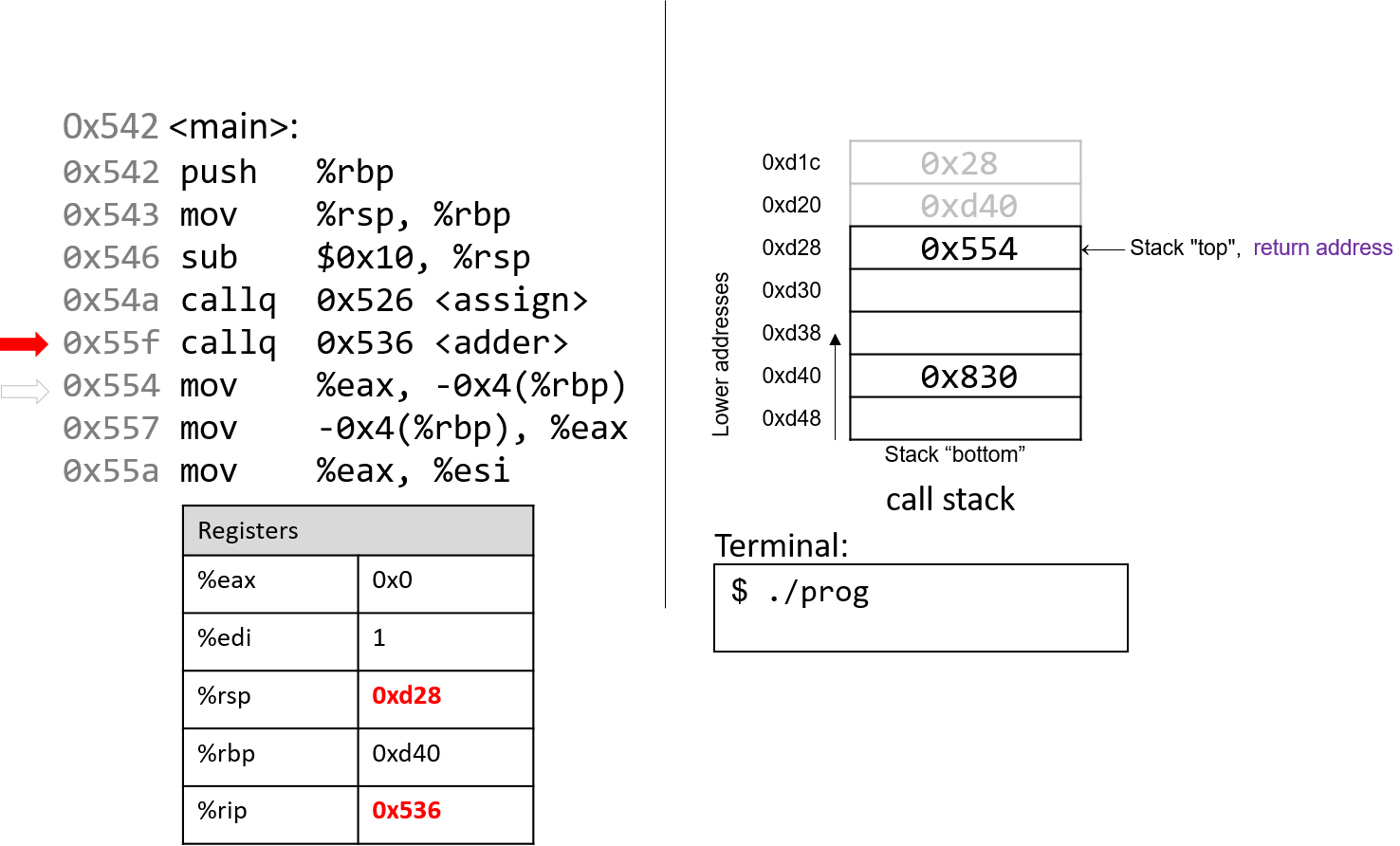
回到 main 中,对 adder 的调用用一个新的返回地址(0x554)覆盖了栈上旧的返回地址。这个返回地址指向 adder 返回后要执行的下一条指令,即 mov %eax, -0x4(%rbp)。寄存器 %rip 更新为指向 adder 中要执行的第一条指令,它位于地址 0x536。
Back in
main, the call toadderoverwrites the old return address on the stack with a new return address (0x554). This return address points to the next instruction to be executed afteradderreturns, ormov %eax, -0x4(%rbp). Register%ripupdates to point to the first instruction to execute inadder, which is at address 0x536.
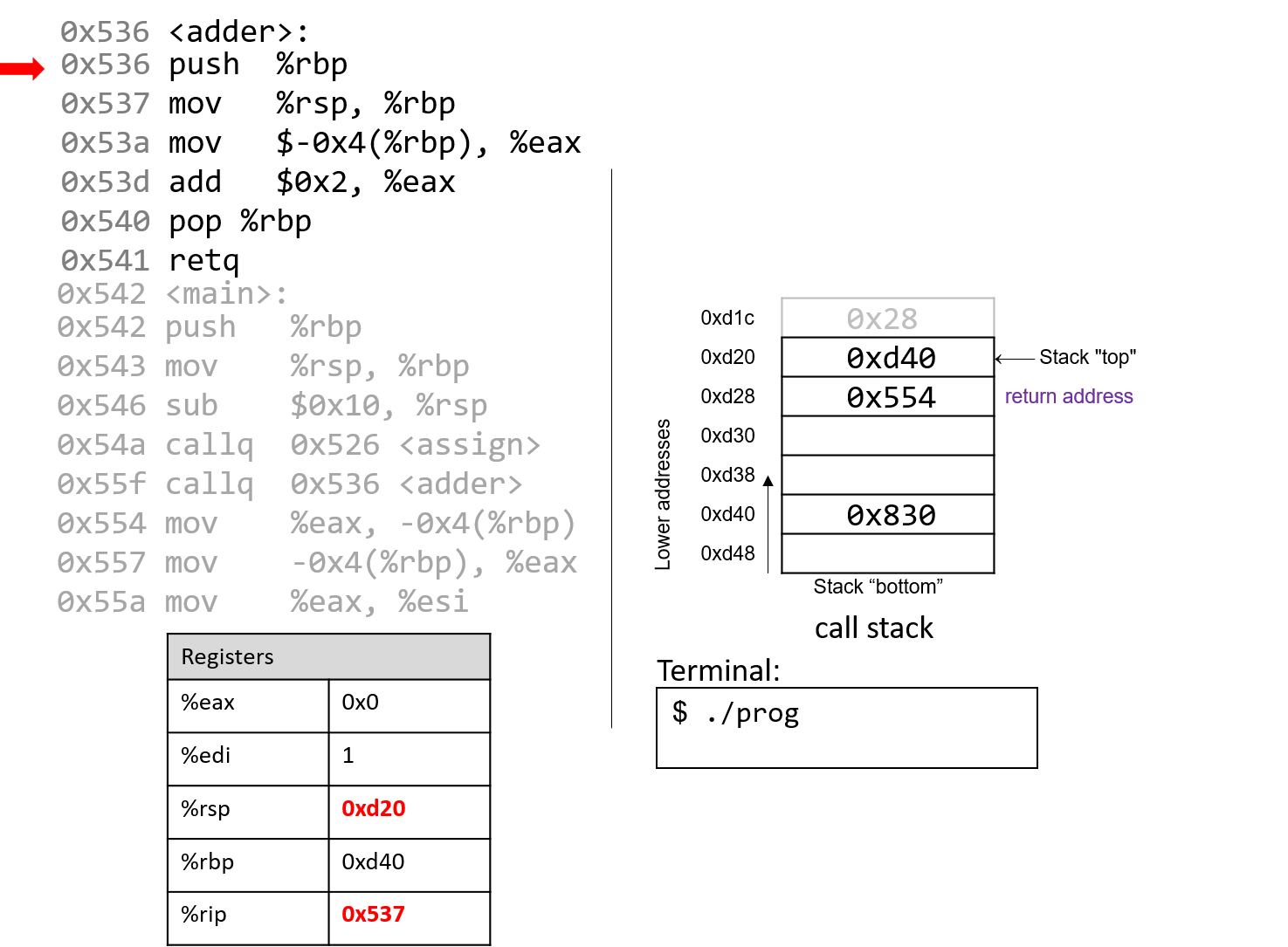
adder 函数中的第一条指令把调用者的帧指针(main 的 %rbp)保存到栈上。
The first instruction in the
adderfunction saves the caller’s frame pointer (%rbpofmain) on the stack.
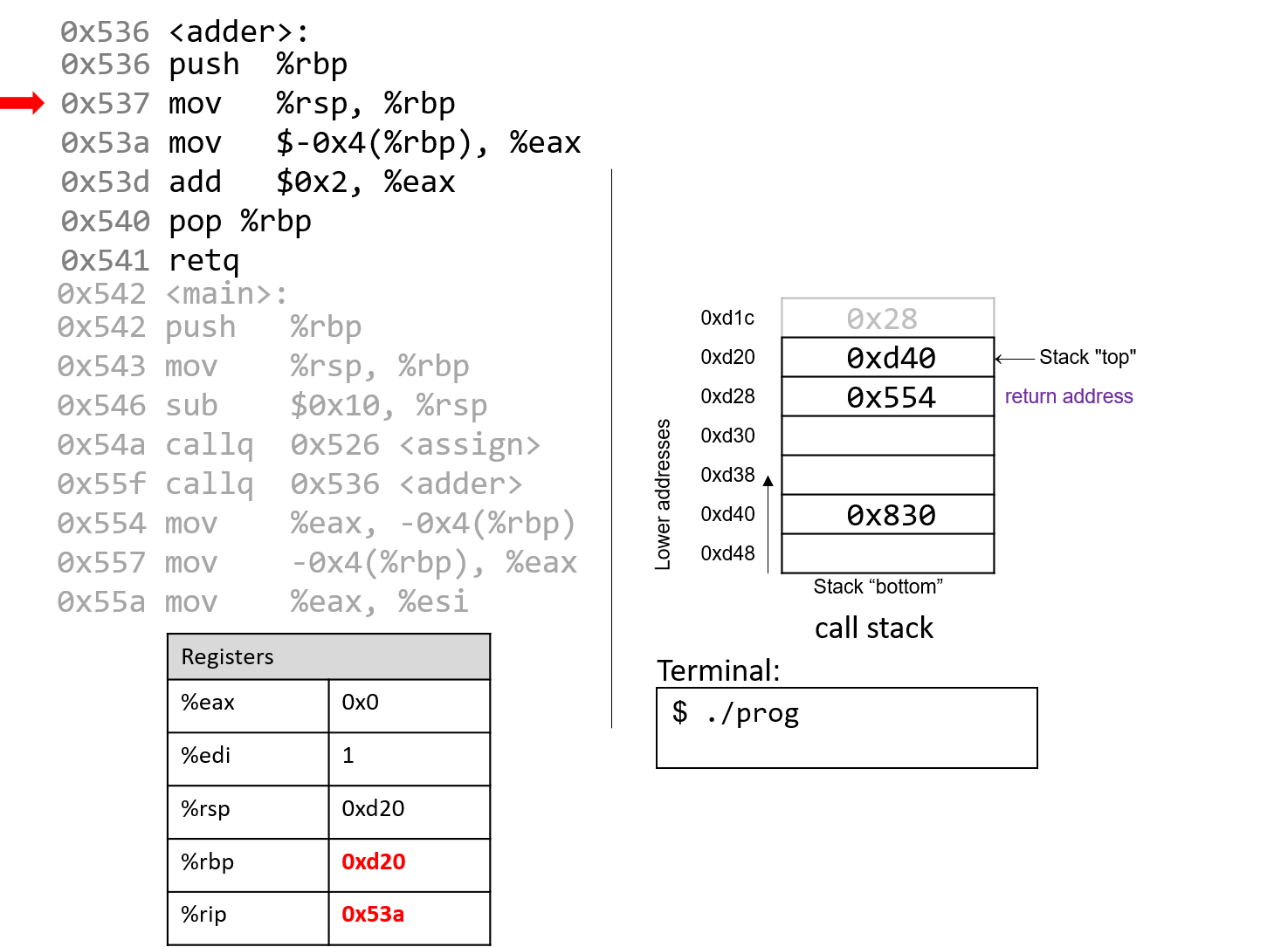
下一条指令用 %rsp 的当前值(即地址 0xd20)更新 %rbp。这两条指令共同确立了 adder 栈帧的开始。
The next instruction updates
%rbpwith the current value of%rsp, or address 0xd20. Together, these last two instructions establish the beginning of the stack frame foradder.
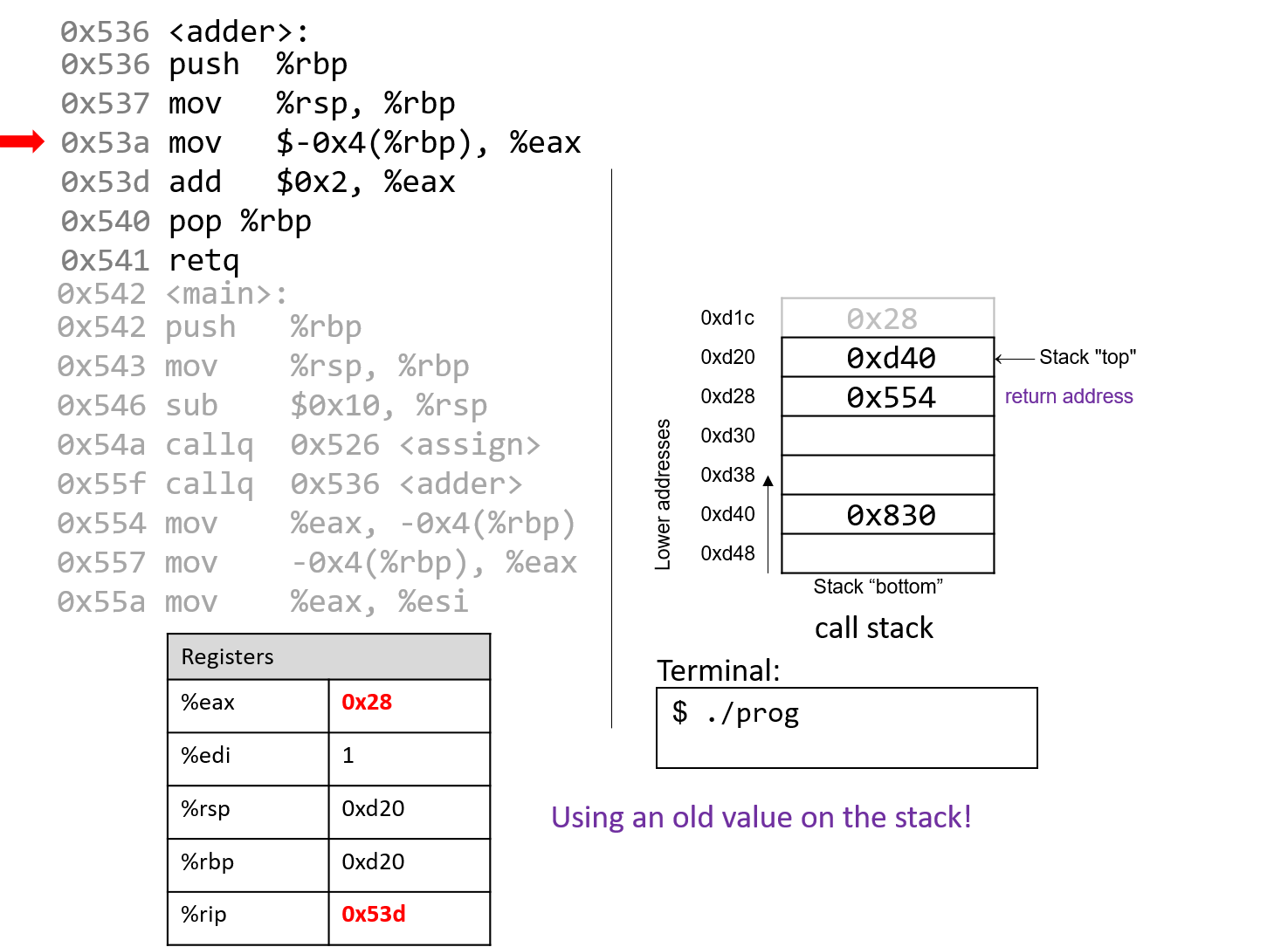
请密切注意接下来执行的这条指令。回想一下,在调用 assign 期间,$0x28 被放到了栈上。mov $-0x4(%rbp), %eax 指令把栈上的一个旧值移入了寄存器 %eax!如果程序员在 adder 函数中初始化了变量 a,就不会发生这种情况。
Pay close attention to the next instruction that executes. Recall that
$0x28was placed on the stack during the call toassign. Themov $-0x4(%rbp), %eaxinstruction moves an old value that is on the stack into register%eax! This would not have occurred if the programmer had initialized variableain theadderfunction.
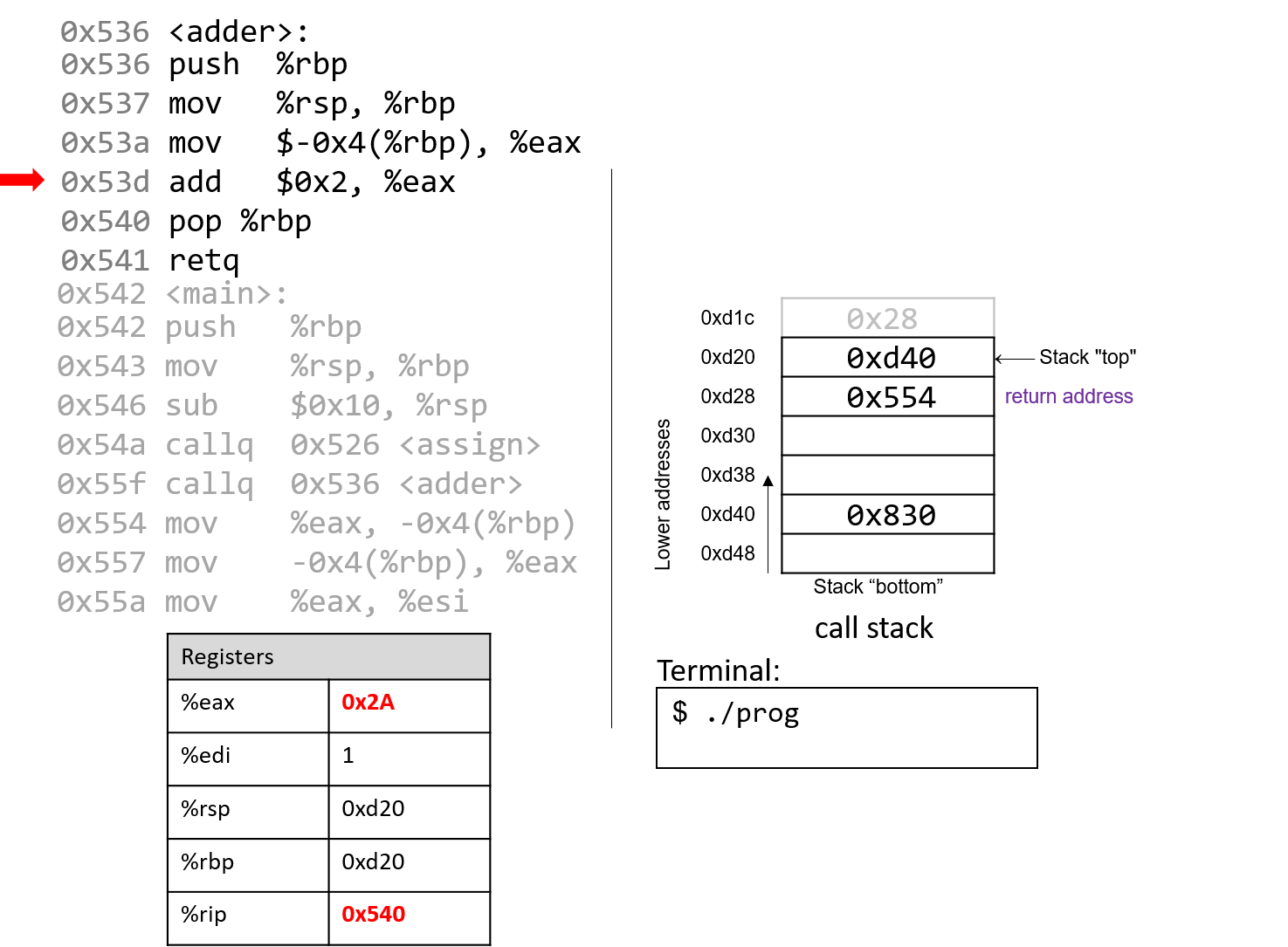
地址 0x53d 处的 add 指令把寄存器 %eax 加 2。回想一下,返回 32 位整数时,x86-64 使用的是组成部分寄存器 %eax 而不是 %rax。最后这两条指令合起来,等价于 adder 中的如下代码:
The
addinstruction at address 0x53d adds 2 to register%eax. Recall that when a 32-bit integer is being returned, x86-64 utilizes component register%eaxinstead of%rax. Together the last two instructions are equivalent to the following code inadder:
1 | int a; |
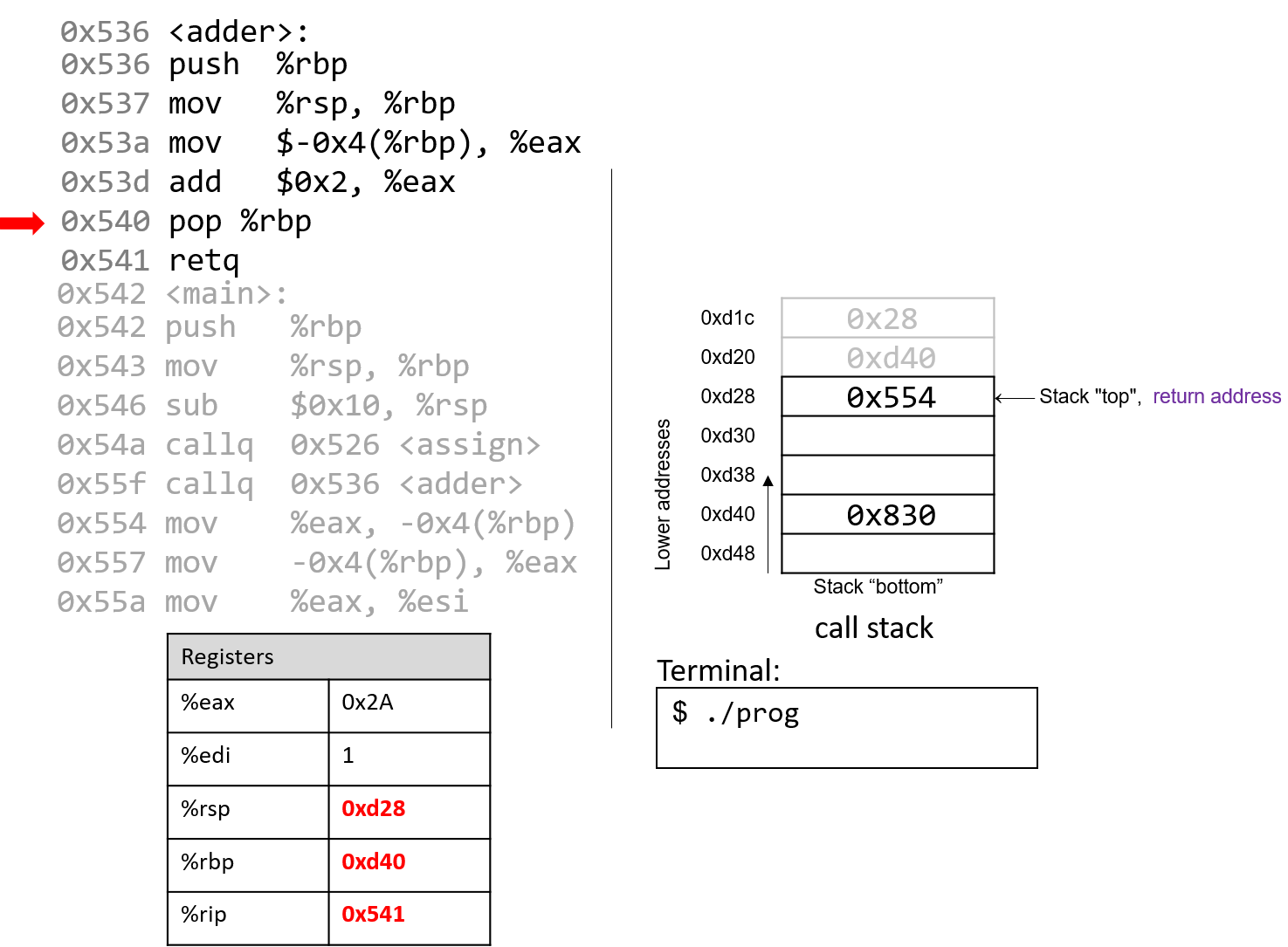
pop 执行之后,帧指针再次指向 main 栈帧的开头,即地址 0xd40。栈指针现在存放的是地址 0xd28。
After
popexecutes, the frame pointer again points to the beginning of the stack frame formain, or address 0xd40. The stack pointer now contains the address 0xd28.
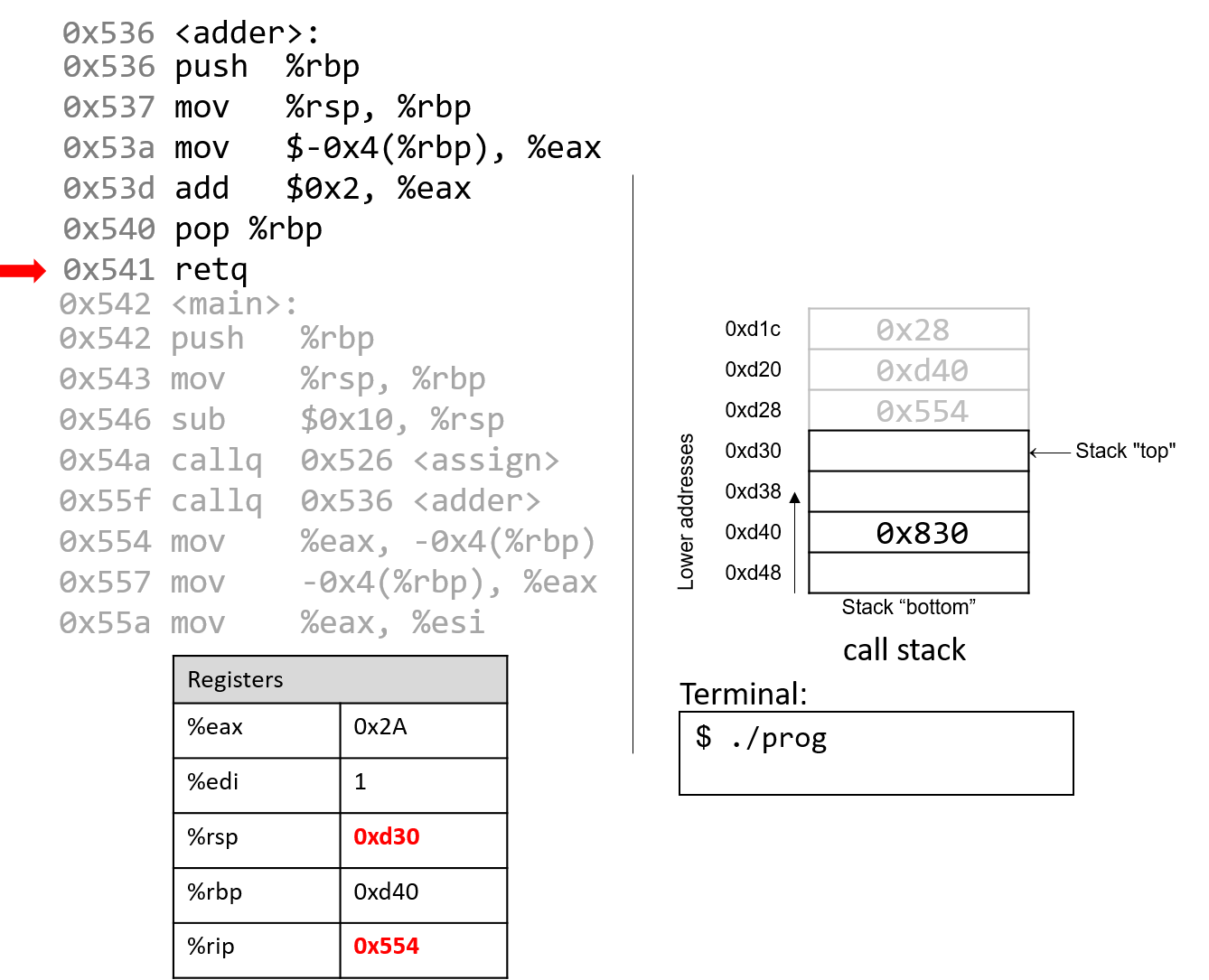
retq 的执行把返回地址从栈中弹出,把指令指针恢复为 0x554,即 main 中下一条要执行的指令的地址。%rsp 中存放的地址现在是 0xd30。
The execution of
retqpops the return address off the stack, restoring the instruction pointer back to 0x554, or the address of the next instruction to execute inmain. The address contained in%rspis now 0xd30.
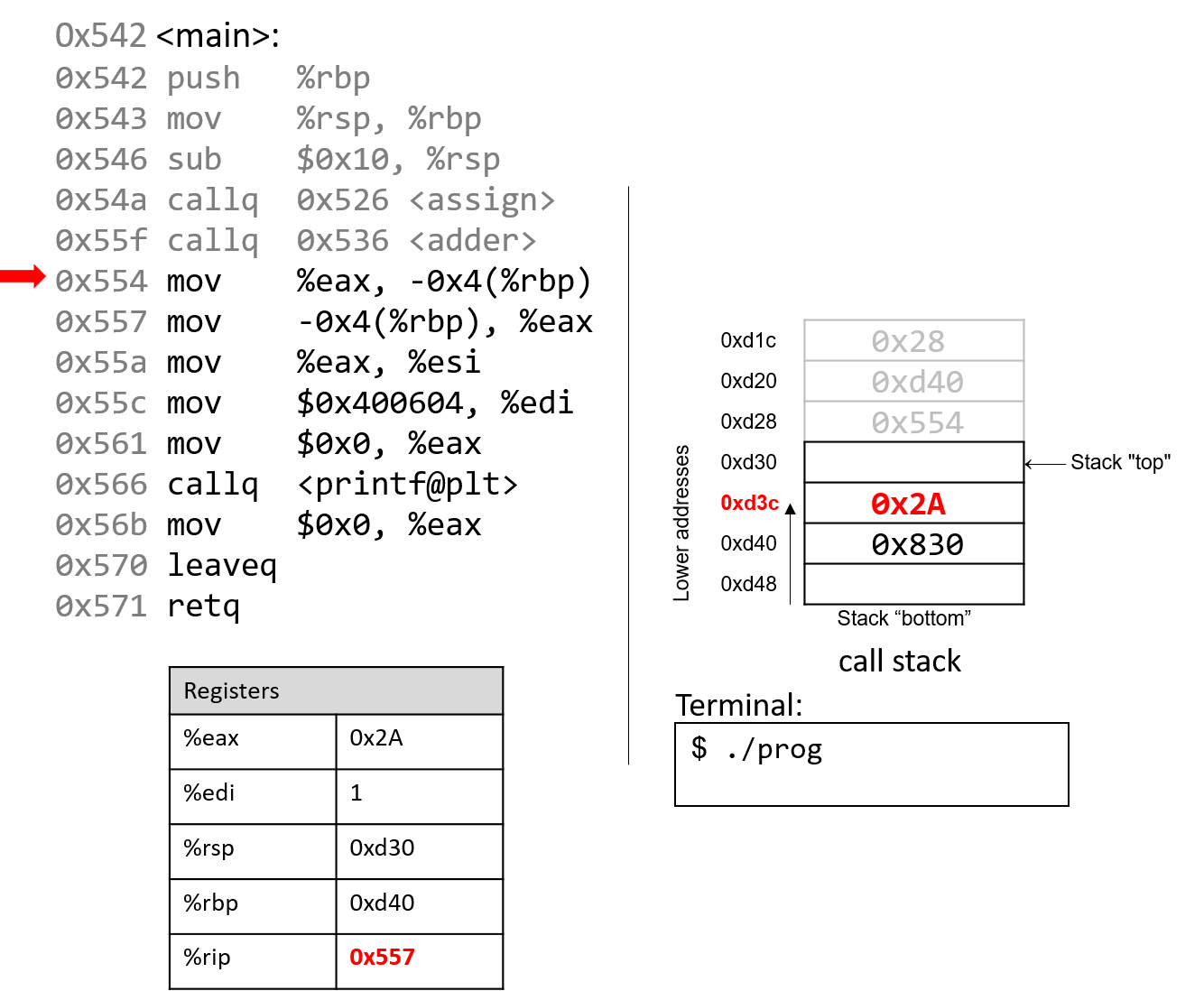
回到 main 中,mov %eax, -0x4(%rbp) 指令把 %eax 中的值放到 %rbp 上方四个字节的位置,即地址 0xd3c。下一条指令又把它放回寄存器 %eax。
Back in
main, themov %eax, -0x4(%rbp)instruction places the value in%eaxat a location four bytes above%rbp, or at address 0xd3c. The next instruction replaces it back into register%eax.
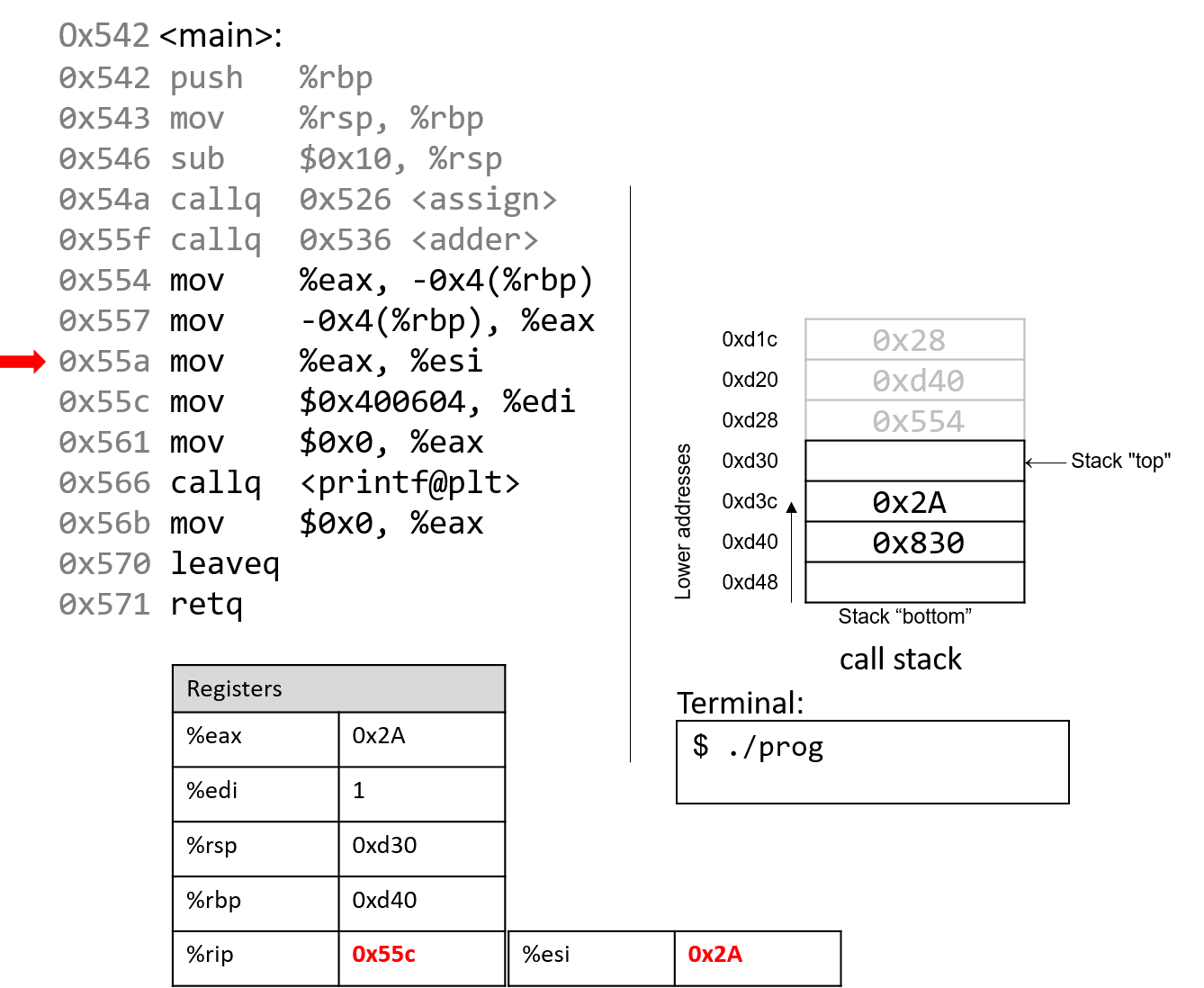
稍微往后跳一点,地址 0x55a 处的 mov 指令把 %eax 中的值(即 0x2A)复制到寄存器 %esi,它是与 %rsi 对应的 32 位组成部分寄存器,通常存放函数的第二个参数。
Skipping ahead a little, the
movinstruction at address 0x55a copies the value in%eax(or 0x2A) to register%esi, which is the 32-bit component register associated with%rsiand typically stores the second parameter to a function.
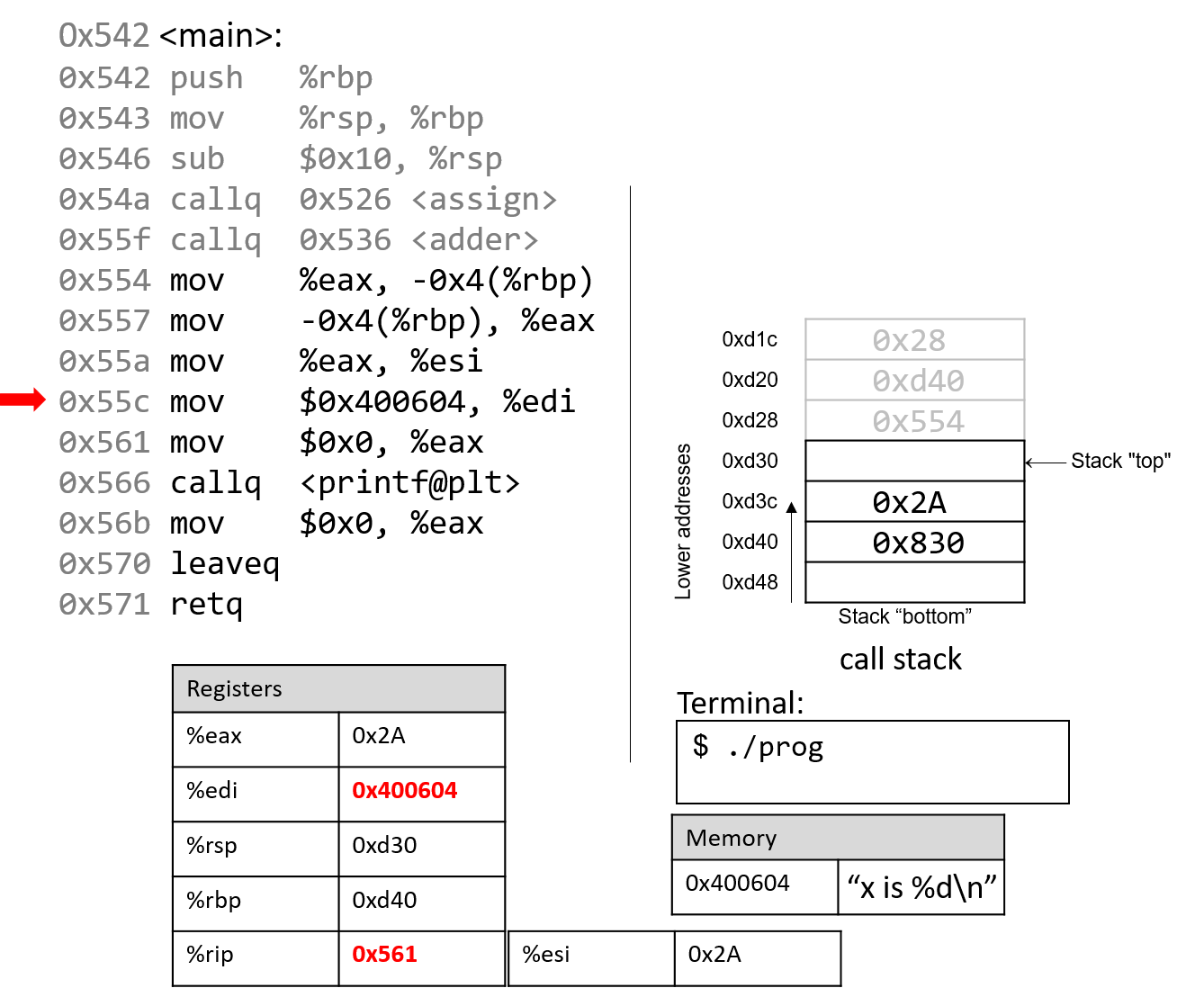
下一条指令(mov $0x400604, %edi)把一个常数值(代码段内存中的一个地址)复制到寄存器 %edi。回想一下,寄存器 %edi 是 %rdi 的 32 位组成部分寄存器,通常存放函数的第一个参数。代码段内存地址 0x400604 是字符串 "x is %d\n" 的基地址。
The next instruction (
mov $0x400604, %edi) copies a constant value (an address in code segment memory) to register%edi. Recall that register%ediis the 32-bit component register of%rdi, which typically stores the first parameter to a function. The code segment memory address 0x400604 is the base address of the string"x is %d\n".
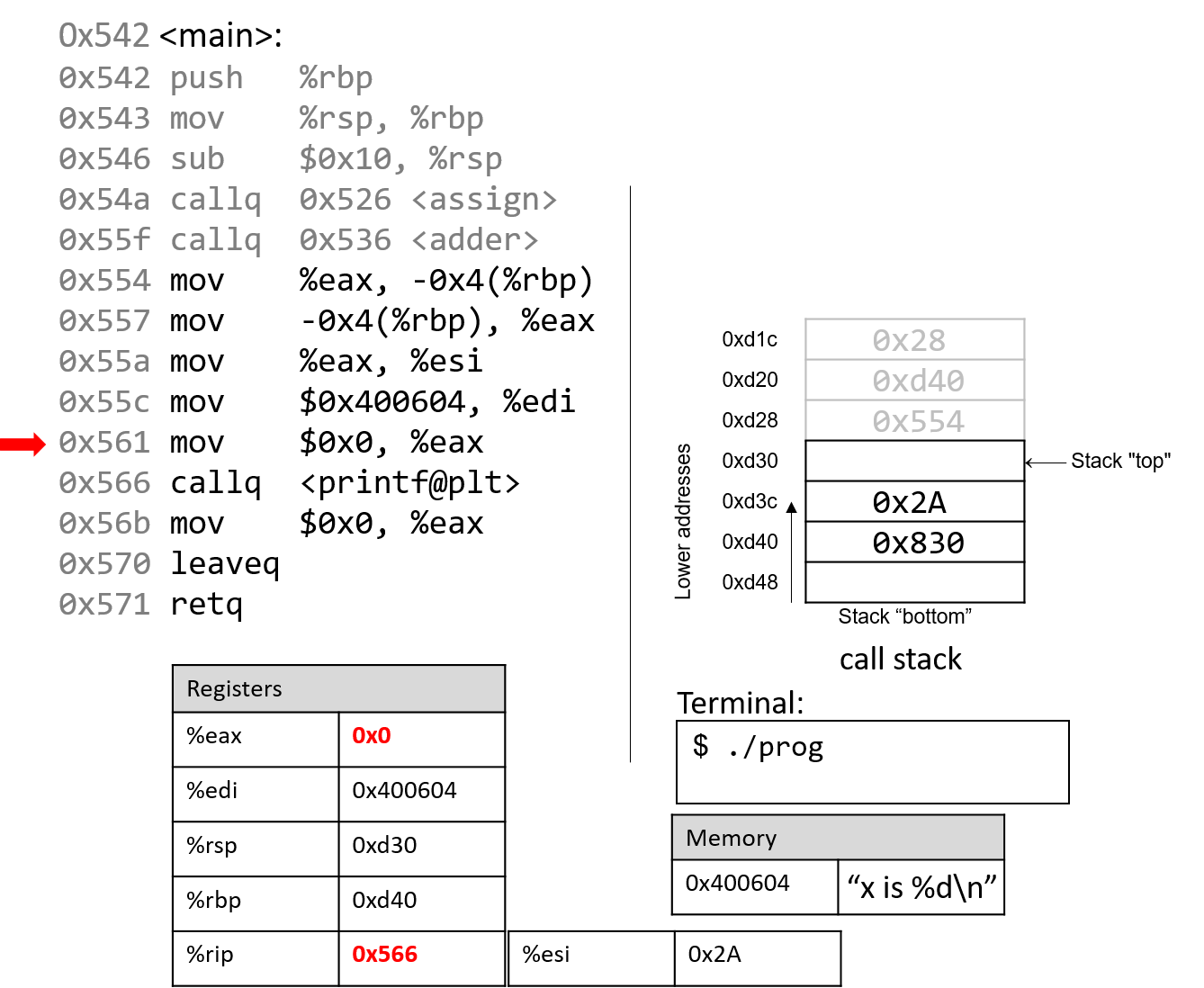
下一条指令把寄存器 %eax 重置为 0。指令指针前进到对 printf 函数的调用处(用标签 <printf@plt> 表示)。
The next instruction resets register
%eaxwith the value 0. The instruction pointer advances to the call to theprintffunction (which is denoted with the label<printf@plt>).
译注
调用 printf 这样的可变参数函数之前把 %eax 清零,并不是随手之举:System V AMD64 调用约定规定,调用可变参数函数时 %al 中要存放用向量寄存器(%xmm0–%xmm7)传递的浮点参数个数,这里没有浮点参数,所以是 0。
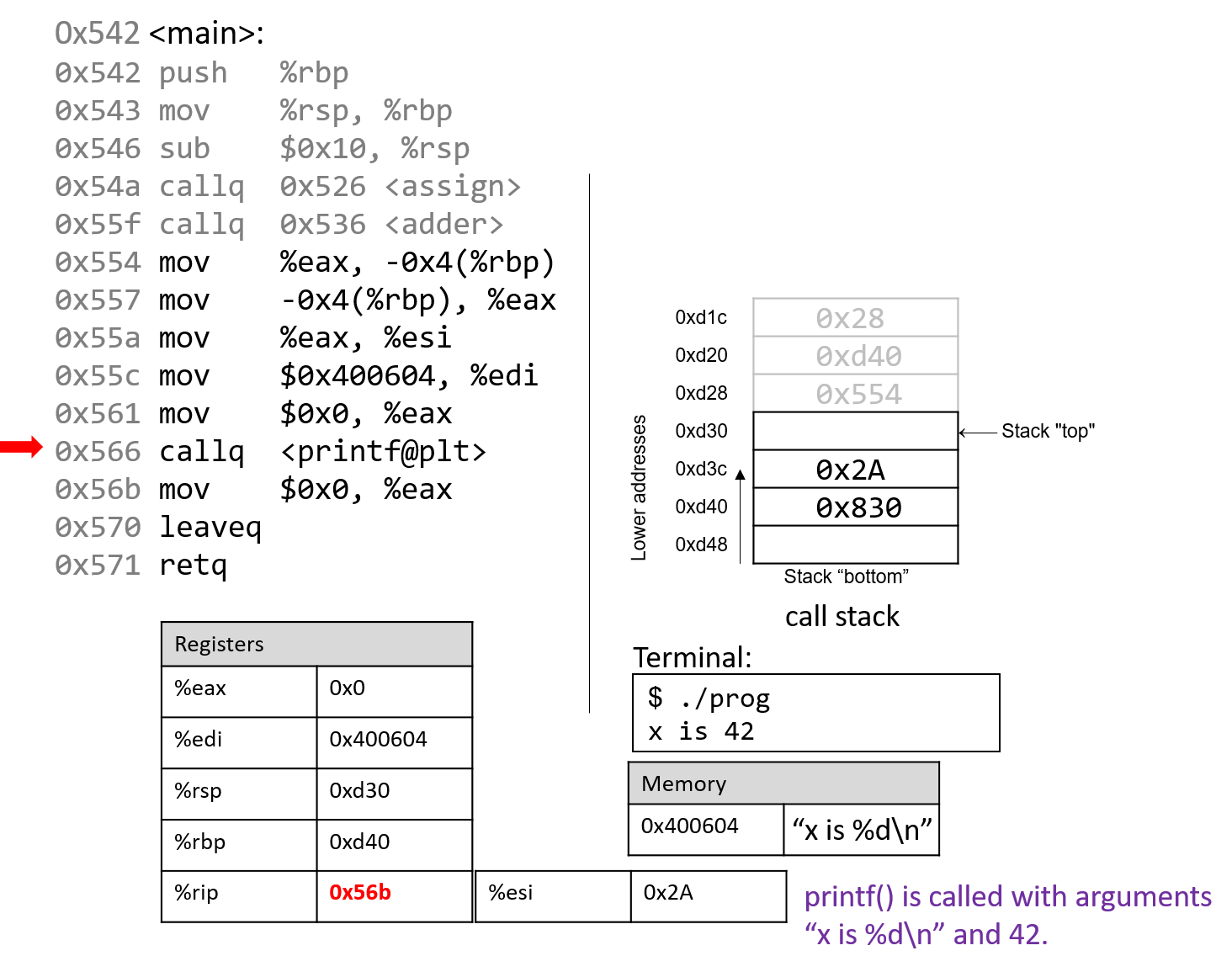
下一条指令调用 printf 函数。为了简洁起见,我们不跟踪 printf 函数,它是 stdio.h 的一部分。不过,从手册页(man -s3 printf)我们知道 printf 的格式如下:
The next instruction calls the
printffunction. For the sake of brevity, we will not trace theprintffunction, which is part ofstdio.h. However, we know from the manual page (man -s3 printf) thatprintfhas the following format:
1 | int printf(const char * format, ...) |
换句话说,第一个参数是指向指定格式的字符串的指针,从第二个参数开始是格式中要用到的值。地址 0x55a–0x566 所指定的那些指令对应于 main 函数中的下面这一行:
In other words, the first argument is a pointer to a string specifying the format, and the second argument onward specify the values that are used in that format. The instructions specified by addresses 0x55a - 0x566 correspond to the following line in the
mainfunction:
1 | printf("x is %d\n", x); |
调用 printf 函数时:
When the
printffunction is called:
- 一个指定
printf调用之后要执行的指令的返回地址被压入栈。
- A return address specifying the instruction that executes after the call to
printfis pushed onto the stack.
%rbp的值被压入栈,%rbp被更新为指向栈顶,表示printf栈帧的开始。
- The value of
%rbpis pushed onto the stack, and%rbpis updated to point to the top of the stack, indicating the beginning of the stack frame forprintf.
在某个时刻,printf 会引用它的参数,即字符串 "x is %d\n" 和值 0x2A。第一个参数存放在组成部分寄存器 %edi 中,第二个参数存放在组成部分寄存器 %esi 中。返回地址位于 %rbp 的正下方,即位置 %rbp+8。
At some point,
printfreferences its arguments, which are the string"x is %d\n"and the value 0x2A. The first parameter is stored in component register%edi, and the second parameter is stored in component register%esi. The return address is located directly below%rbpat location%rbp+8.
对于任何有 n 个参数的函数,GCC 把前六个参数放在寄存器中(如表 2 所示),把其余的参数放在栈上返回地址的下方。
For any function with n arguments, GCC places the first six arguments in registers, as shown in Table 2, and the remaining arguments onto the stack below the return address.
调用 printf 之后,值 0x2A 以整数格式输出给用户。于是,屏幕上打印出了值 42!
After the call to
printf, the value 0x2A is output to the user in integer format. Thus, the value 42 is printed to the screen!
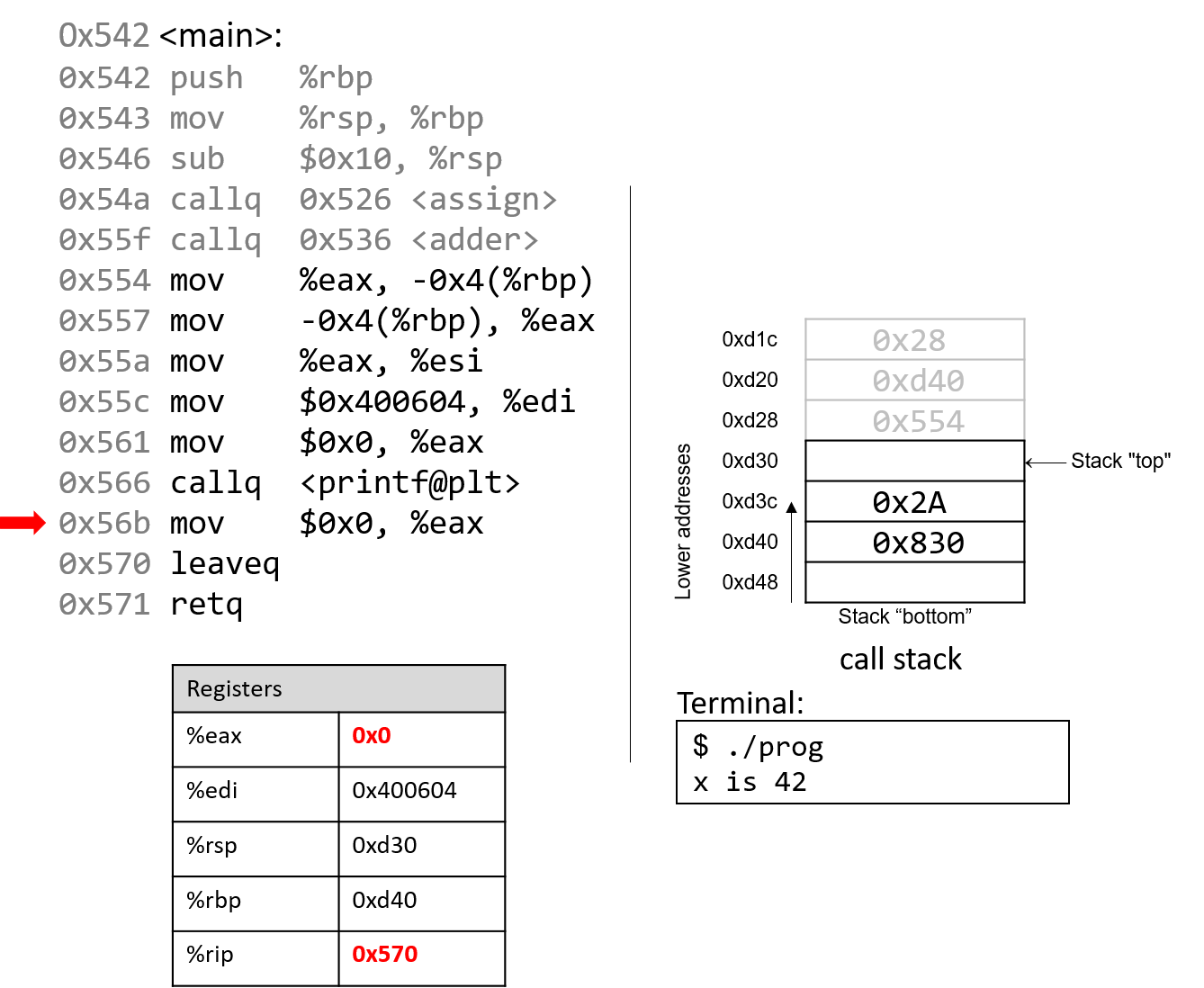
调用 printf 之后,最后几条指令清理栈,为从 main 函数干净地退出做准备。首先,地址 0x56b 处的 mov 指令确保返回寄存器中是 0(因为 main 做的最后一件事是返回 0)。
After the call to
printf, the last few instructions clean up the stack and prepare a clean exit from themainfunction. First, themovinstruction at address 0x56b ensures that 0 is in the return register (since the last thingmaindoes is return 0).
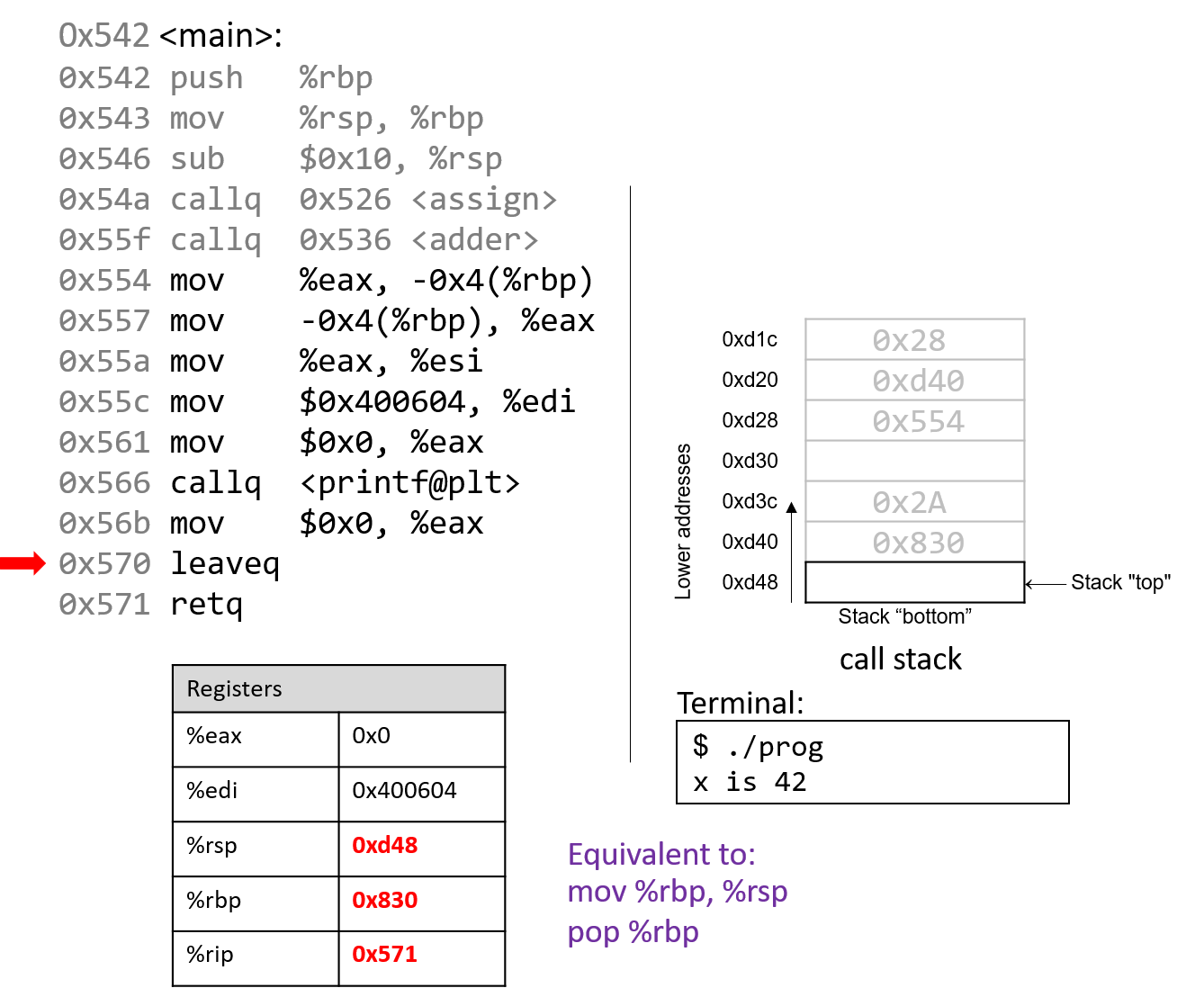
leaveq 指令为从函数调用返回准备好栈。回想一下,leaveq 相当于下面这一对指令:
The
leaveqinstruction prepares the stack for returning from the function call. Recall thatleaveqis analogous to the following pair of instructions:
1 | mov %rbp, %rsp |
换句话说,CPU 用帧指针覆盖栈指针。在我们的例子中,栈指针先从 0xd30 被更新为 0xd40。接着,CPU 执行 pop %rbp,取出位于 0xd40 处的值(在我们的例子中是地址 0x830),放入 %rbp。leaveq 执行之后,栈指针和帧指针都恢复为执行 main 之前的原始值。
In other words, the CPU overwrites the stack pointer with the frame pointer. In our example, the stack pointer is initially updated from 0xd30 to 0xd40. Next, the CPU executes
pop %rbp, which takes the value located at 0xd40 (in our example, the address 0x830) and places it in%rbp. Afterleaveqexecutes, the stack and frame pointers revert to their original values prior to the execution ofmain.
最后执行的指令是 retq。返回寄存器 %eax 中是 0x0,程序返回零,表示正常终止。
The last instruction that executes is
retq. With 0x0 in the return register%eax, the program returns zero, indicating correct termination.
如果你仔细读完了这一节,就应该明白我们的程序为什么会打印出值 42。从本质上说,程序无意中用到了栈上的旧值,使它表现出我们没有预料到的行为。这个例子还算无害;不过,我们会在后面的小节中讨论黑客是如何滥用函数调用,让程序以真正恶意的方式出错的。
If you have carefully read through this section, you should understand why our program prints out the value 42. In essence, the program inadvertently uses old values on the stack to cause it to behave in a way that we didn’t expect. This example was pretty harmless; however, we discuss in future sections how hackers have misused function calls to make programs misbehave in truly malicious ways.