
说明
本文是个人学习用的非官方中英对照译文,原文:https://diveintosystems.org/book/C13-OS/exercises.html。
原书采用 CC BY-NC-ND 4.0 许可(禁止演绎),请勿公开传播本译文。
标为「译注」「现代更新」的内容是译者补充,不代表原书作者观点;代码与原文逐字一致,未作改动。
13.6. Exercises
- 第 13 章全部练习(英文交互式练习)
附加练习
Additional Exercises
- 考虑下面这段调用了 fork 的代码片段(为了可读性去掉了错误处理代码):
- Consider the code snippet below with calls to fork (and with error handling code removed just for readability sake):
1 | pid_t ret; |
- 画出执行这段代码所创建的进程层次结构。
- Draw the process hierarchy created by executing this code.
- 对层次结构中的每个进程,指出它的输出序列(它执行各个 printf 的顺序)。
- For each process in the hierarchy, indicate its output sequence (the order in which it executes printf’s).
解答
Solutions
如果你的浏览器支持隐藏答案,点击这里显示答案。
If your browser supports hidden solutions, click here to reveal them.
\
对于这段代码片段:
1
2
3
4
5
6
7
8
9
10
11
12
13
14
15
16
17
int ret;
printf("A\n");
ret = fork(); // fork 1
if(ret == 0) {
printf("B\n");
ret = fork(); // fork 2
if(ret == 0) {
print("C\n");
}
printf("D\n");
} else {
printf("E\n");
ret = fork(); // fork 3
printf("F\n");
}
printf("G\n");执行这段代码所创建的进程层次结构如下(层次结构的每条边上都标注了创建对应进程的那次 fork 调用):
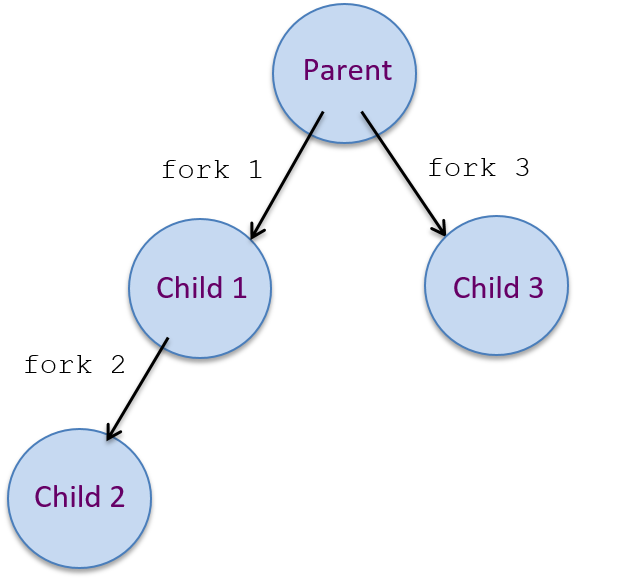
图示:一个由 4 个进程组成的进程层次结构:父进程通过 fork 1 创建子进程 1,子进程 1 通过 fork 2 创建它的子进程,即子进程 2,父进程通过 fork 3 创建它的第二个子进程,即子进程 3
层次结构中每个进程的输出序列(它按什么顺序执行哪些 printf):
1
2
3
4
parent: A, E, F, G
child1: B, D, G
child2: F, G
child3: C, D, G
For the code snippet:
2
3
4
5
6
7
8
9
10
11
12
13
14
15
16
17
printf("A\n");
ret = fork(); // fork 1
if(ret == 0) {
printf("B\n");
ret = fork(); // fork 2
if(ret == 0) {
print("C\n");
}
printf("D\n");
} else {
printf("E\n");
ret = fork(); // fork 3
printf("F\n");
}
printf("G\n");The process heirarchy created by executing this code (the specific fork call that creates each process is annotated on each edge in the process heirarchy):
For each process in the heirarchy, indicate its output sequence (which printf’s it executes in which order):
2
3
4
child1: B, D, G
child2: F, G
child3: C, D, G
译注 · 解答中的两处错误
- 代码中的
print("C\n");应为printf("C\n");,否则无法编译。 - 按图中的命名(子进程 2 由 fork 2 创建、子进程 3 由 fork 3 创建),输出序列中 child2 和 child3 两行写反了:子进程 2 是子进程 1 在 fork 2 处创建的,它从 fork 2 之后开始执行,输出 C、D、G;子进程 3 是父进程在 fork 3 处创建的,输出 F、G。